


What is the cross - sectional area of a hexagon nut?
Apr 01, 2026
Leave a message
When it comes to fasteners, the hexagon nut is a ubiquitous component in a wide range of industries, from construction to automotive manufacturing. As a dedicated hexagon nut supplier, I often encounter inquiries about the cross - sectional area of these nuts. In this blog, we'll delve deep into what the cross - sectional area of a hexagon nut is, why it matters, and how it relates to different types of hexagon nuts we offer.
Understanding the Basic Geometry of a Hexagon Nut
A hexagon nut, as the name implies, has a hexagonal shape on its outer perimeter. A regular hexagon can be divided into six equilateral triangles. Each side of the equilateral triangle is equal to the length of one side of the hexagon. Let's denote the side length of the hexagonal nut as (s).
The area of an equilateral triangle with side length (s) can be calculated using the formula (A_{\triangle}=\frac{\sqrt{3}}{4}s^{2}). Since a regular hexagon is composed of six such equilateral triangles, the area of the regular hexagon (A_{hexagon}= \frac{3\sqrt{3}}{2}s^{2}\approx2.598s^{2})
In the case of a hexagon nut, the cross - sectional area we are interested in usually refers to the area of the regular hexagon formed by the outer edges of the nut. For example, if we have a hexagon nut with a side length (s = 5\space mm), then the cross - sectional area (A=\frac{3\sqrt{3}}{2}\times(5)^{2}\approx2.598\times25 = 64.95\space mm^{2})
Practical Significance of the Cross - Sectional Area
The cross - sectional area of a hexagon nut is not just a theoretical value; it has several practical implications:
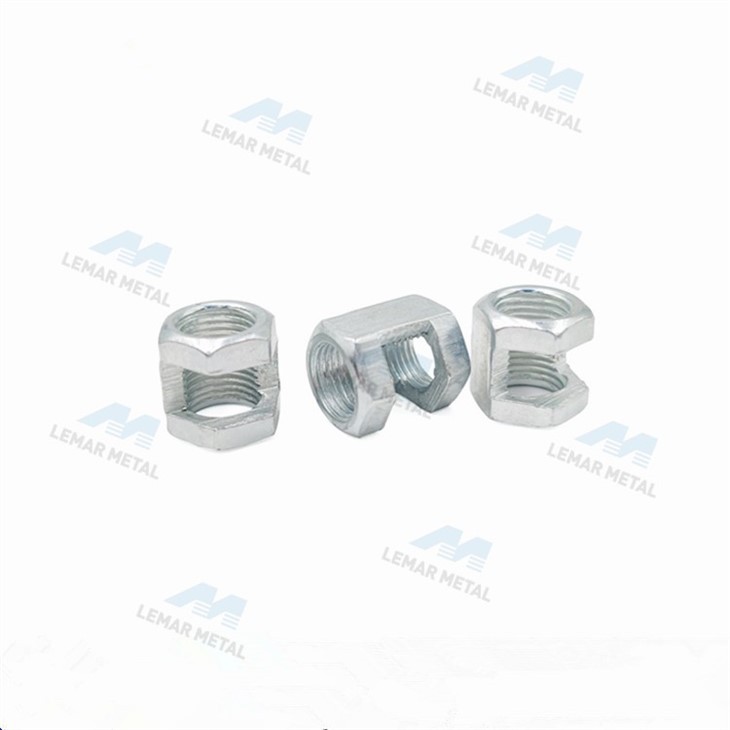

Strength and Load - Bearing Capacity
A larger cross - sectional area generally means that the nut can withstand greater forces without deforming or breaking. In high - stress applications, such as in heavy machinery or structural engineering, nuts with a larger cross - sectional area are often preferred. For instance, in a bridge construction project, the nuts used to secure the steel beams need to have sufficient cross - sectional areas to handle the large loads and vibrations.
Heat Dissipation
In applications where the nut is subject to high temperatures, such as in engines or electrical equipment, a larger cross - sectional area can facilitate better heat dissipation. The increased surface area allows for more efficient transfer of heat to the surrounding environment, preventing the nut from overheating and potentially failing.
Material Selection and Cost
The cross - sectional area also affects the amount of material required to manufacture the nut. A larger cross - sectional area means more material is used, which can increase the cost. This is why understanding the cross - sectional area is crucial when selecting the appropriate nut for a specific application, as it can help balance the performance requirements with the cost.
Cross - Sectional Area and Different Types of Hexagon Nuts
As a hexagon nut supplier, we offer a variety of hexagon nuts made from different materials, each with its own characteristics and applications.
Brass Thin Nut
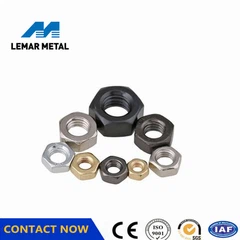
Brass thin nuts are known for their corrosion resistance and aesthetic appeal. They are often used in applications where a more delicate appearance is desired, such as in furniture or decorative hardware. The cross - sectional area of brass thin nuts is relatively small compared to other types, as they are designed to be lightweight and unobtrusive. However, they still need to have enough area to provide sufficient strength for the intended application.
Iron Hexagon Nut M10
Iron hexagon nuts, like the M10 size, are commonly used in general - purpose applications. They are relatively strong and durable, and their cross - sectional area is designed to meet the requirements of a wide range of loads. For a standard M10 iron hexagon nut, the side length (s) can be determined based on the relevant standards, and then the cross - sectional area can be calculated using the formula mentioned earlier.
Hexagon Copper Nut
Copper hexagon nuts offer excellent electrical conductivity in addition to good corrosion resistance. They are often used in electrical and electronic applications, such as in circuit boards or electrical enclosures. The cross - sectional area of copper hexagon nuts can vary depending on the specific requirements of the electrical connection, as a larger cross - sectional area can reduce resistance and improve electrical performance.
Measuring the Cross - Sectional Area of a Hexagon Nut
In practice, measuring the cross - sectional area of a hexagon nut is relatively straightforward. You can use a caliper to measure the side length (s) of the hexagon. Make sure to measure at several points around the nut to ensure accuracy, as there may be slight variations in the manufacturing process. Once you have the side length, you can simply plug it into the formula (A=\frac{3\sqrt{3}}{2}s^{2}) to calculate the cross - sectional area.
Conclusion and Invitation to Contact
Understanding the cross - sectional area of a hexagon nut is essential for selecting the right nut for your specific application. Whether you need a high - strength nut for heavy - duty machinery or a corrosion - resistant nut for a marine environment, we, as a professional hexagon nut supplier, can provide you with the best solutions.
If you are interested in our Brass Thin Nut, Iron Hexagon Nut M10, Hexagon Copper Nut or any other types of hexagon nuts, please feel free to contact us for more information and to start a procurement discussion. We are committed to providing high - quality products and excellent service to meet your needs.
References
- "Mechanical Engineering Handbook", edited by Myer Kutz.
- "Fasteners and Their Application", by H. B. DuBois.
Send Inquiry