


What is the friction coefficient of a flat washer?
Sep 29, 2025
Leave a message
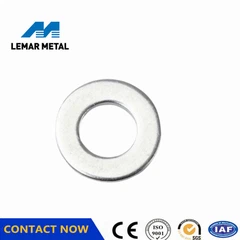
Friction coefficient plays a crucial role in the performance and application of flat washers. As a reliable flat washer supplier, I am well - versed in the concept of friction coefficient and its significance in the context of flat washers. In this blog, we will delve deep into what the friction coefficient of a flat washer is, how it affects the washer's functionality, and the factors that influence it.
Understanding Friction Coefficient
The friction coefficient, often denoted as μ, is a dimensionless quantity that represents the ratio of the force of friction between two surfaces in contact to the normal force pressing the two surfaces together. In the case of a flat washer, the friction coefficient determines how much resistance there is when the washer is in contact with other components, such as a bolt head, nut, or the surface of a machine part.
Mathematically, the friction force (F_f) can be calculated using the formula (F_f=\mu N), where (N) is the normal force. For example, if a flat washer is placed under a bolt and tightened, the normal force is the clamping force exerted by the bolt. The friction coefficient then dictates how much frictional force is generated between the washer and the mating surface.
Why Friction Coefficient Matters for Flat Washers
1. Clamping Force Maintenance
One of the primary functions of a flat washer is to distribute the load evenly and maintain the clamping force of a bolted joint. A proper friction coefficient ensures that the washer does not slip easily under the applied load. If the friction coefficient is too low, the washer may slide, causing the clamping force to decrease over time. This can lead to loosening of the bolted joint, which is a serious issue in many applications, such as automotive engines, machinery, and structural assemblies.
2. Wear and Tear
The friction coefficient also affects the wear and tear of the flat washer and the mating surfaces. A high - friction coefficient can result in increased wear, as more force is required to move the surfaces relative to each other. On the other hand, a very low friction coefficient may cause the washer to move freely, leading to uneven wear patterns. Therefore, an optimal friction coefficient is necessary to ensure the longevity of both the washer and the components it is in contact with.


3. Torque - Tension Relationship
When tightening a bolt, the torque applied is related to the resulting tension in the bolt. The friction coefficient between the flat washer and the bolt head or nut affects this relationship. A consistent friction coefficient allows for more accurate torque - tension calculations, which is essential for achieving the desired clamping force in a bolted joint.
Factors Affecting the Friction Coefficient of Flat Washers
1. Material
The material of the flat washer is one of the most significant factors influencing the friction coefficient. Different materials have different surface properties, which can lead to variations in friction. For instance, Copper Flat Washer has a relatively low friction coefficient compared to some harder metals. Copper is a soft metal, and its surface is more likely to deform slightly under pressure, reducing the frictional resistance.
On the other hand, Stainless Steel 304 Flat Washer and Stainless Steel Flat Washer generally have higher friction coefficients. Stainless steel has a harder surface, and the interaction between the stainless - steel washer and the mating surface creates more frictional force.
2. Surface Finish
The surface finish of the flat washer also plays a crucial role. A smooth surface finish will typically result in a lower friction coefficient compared to a rough surface. A smooth washer can slide more easily over the mating surface, while a rough surface will have more asperities that interlock with the other surface, increasing the frictional force. Surface treatments such as polishing, grinding, or coating can be used to modify the surface finish and, consequently, the friction coefficient.
3. Lubrication
Lubrication can significantly reduce the friction coefficient of a flat washer. When a lubricant is applied between the washer and the mating surface, it forms a thin film that separates the two surfaces. This film reduces the direct contact between the asperities of the surfaces, thereby lowering the frictional force. However, the type of lubricant used and the application method can affect the effectiveness of the lubrication.
4. Temperature
Temperature can also influence the friction coefficient. As the temperature increases, the material properties of the flat washer and the mating surface may change. For example, some materials may expand or become softer at higher temperatures, which can alter the surface contact and the frictional force. In high - temperature applications, it is essential to consider the temperature - dependent behavior of the friction coefficient to ensure the proper functioning of the bolted joint.
Measuring the Friction Coefficient of Flat Washers
There are several methods to measure the friction coefficient of flat washers. One common method is the inclined - plane test. In this test, the flat washer is placed on an inclined plane, and the angle of the plane is gradually increased until the washer starts to slide. The tangent of the angle at which the washer begins to slide is equal to the friction coefficient.
Another method is the use of a friction - testing machine. This machine applies a known normal force to the washer and measures the frictional force required to move the washer relative to the mating surface. The friction coefficient is then calculated by dividing the frictional force by the normal force.
Selecting the Right Flat Washer Based on Friction Coefficient
When selecting a flat washer for a specific application, it is crucial to consider the required friction coefficient. For applications where high clamping force and minimal slippage are required, a washer with a relatively high friction coefficient may be preferred. For example, in heavy - duty machinery or structural applications, a Stainless Steel Flat Washer with a higher friction coefficient can provide better performance.
On the other hand, if the application requires easy adjustment or if there is a risk of excessive wear due to high friction, a washer with a lower friction coefficient, such as a Copper Flat Washer, may be more suitable.
Conclusion
In conclusion, the friction coefficient of a flat washer is a critical parameter that affects its performance in various applications. As a flat washer supplier, we understand the importance of providing washers with the appropriate friction coefficient for different customer needs. By considering factors such as material, surface finish, lubrication, and temperature, we can help our customers select the right flat washer for their specific applications.
If you are in need of high - quality flat washers and have questions about the friction coefficient or any other aspect of our products, please feel free to contact us for a detailed discussion. We are committed to providing the best solutions for your flat - washer requirements.
References
- Bowden, F. P., & Tabor, D. (1950). Friction and Lubrication of Solids. Oxford University Press.
- Holms, J. P. (1996). Handbook of Fastener Technology. Industrial Press Inc.
- Mischke, C. R., & Shigley, J. E. (2004). Mechanical Engineering Design. McGraw - Hill.
Send Inquiry