

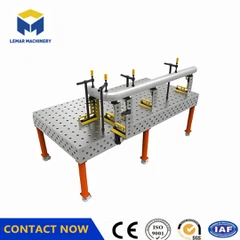
How to determine if a 3D welding table has undergone moderate deformation
Jun 17, 2026
Leave a message
Core Quantitative Criteria (Definitive Basis)
Moderate deformation is determined if both of the following conditions are met:
1. Planar warping/distortion: The maximum deformation falls between 0.03 mm/1000 mm and 0.10 mm/1000 mm; this exceeds the factory acceptance tolerance (≤0.05 mm/1000 mm) but does not reach the threshold for severe deformation.
2. Positioning hole center-to-center deviation: The deviation in the center-to-center distance of positioning holes is between ±0.05 mm and ±0.10 mm, and the perpendicularity deviation is between 0.05 mm/200 mm and 0.10 mm/200 mm.
If all precision metrics fall within these ranges, the condition is classified as moderate deformation.
Auxiliary Verification via Visual Characteristics (Preliminary assessment possible without precision instruments)
1. No obvious warping, buckling, or unevenness is visible to the naked eye; however, after adjusting the support pads, a frame level detects a consistent deviation.
2. Positioning locking pins can be inserted into the positioning holes normally without hindering basic clamping, though slight positioning errors occur when clamping large-sized workpieces.
3. The welding table sits stably without wobbling, and there are no visible cracks or structural damage.

Send Inquiry