

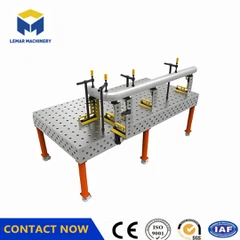







How to Extend the Calibration Cycle of a 3D Welding Table
Apr 29, 2026
Leave a message
1. Control the Stability of the Operating Environment
Maintain constant temperature and humidity (temperature 20±2℃, humidity 40–60%) to avoid metal deformation caused by thermal expansion and contraction.
Keep away from vibration sources (such as stamping machines and forging equipment) to prevent structural loosening that could affect positioning accuracy.
Protect from dust and pollution to reduce the erosion of guide rails and holes by dust, oil, and corrosive gases.
2. Standardize Operation and Load Management
Avoid overloading; the weight of the workpiece should be controlled within the platform's load-bearing capacity (usually ≤10 tons/㎡).
Distribute force evenly to avoid long-term concentrated loading in localized areas, preventing localized depressions or deformation of the table surface.
Do not install workpieces by hammering, prying, or other methods to protect T-slots and positioning holes from mechanical damage.
3. Strengthen Daily Maintenance and Cleaning
Remove iron filings, welding slag, and oil after each use to prevent impurities from embedding in the slots and causing "lifting" or jamming.
Regularly apply rust-preventive oil, especially in humid environments, to prevent oxidation and rust on the cast iron surface.
Lubricate sliding parts (such as T-slot sliders) to ensure smooth, unobstructed operation.
4. Implementation Verification and Trend Analysis: Perform repeated positioning tests monthly using standard modules or workpieces of known dimensions, recording deviation data.
If the results are consistently stable (deviation ≤ ±0.08mm) over multiple tests, this can be used as a basis for extending the calibration cycle.
Establish a calibration history archive, analyze drift trends, and dynamically adjust the cycle using a "stepped response" strategy.
5. Select High-Stability Materials and Processes: Prioritize HT300 cast iron platforms that have undergone two artificial aging processes followed by natural aging, resulting in more thorough stress removal and better long-term stability.
High-precision platforms can support longer calibration cycles due to their high initial accuracy and slow drift.
6. Introduce Predictive Calibration Management: Utilize sensors or 3D vision systems for status monitoring and real-time assessment of platform performance changes.
By combining historical data with AI algorithms to predict the next calibration time, this replaces the fixed-cycle approach and improves management efficiency.
✅ Important Note: Extending the calibration cycle must be based on actual test data and should not be done blindly. If increased positioning deviation or decreased repeatability is detected, the regular calibration frequency should be restored immediately.

Send Inquiry