



What is the spring rate of a spring washer?
Jun 12, 2026
Leave a message
What is the Spring Rate of a Spring Washer?
As a supplier of spring washers, I often encounter questions about the spring rate of these essential components. Understanding the spring rate is crucial for various applications, from automotive to industrial machinery. In this blog post, I will delve into the concept of spring rate, its significance, and how it relates to spring washers.
Understanding Spring Rate
The spring rate, also known as the stiffness or spring constant, is a measure of the force required to compress or extend a spring by a certain distance. It is typically expressed in units of force per unit length, such as pounds per inch (lb/in) or newtons per millimeter (N/mm). A higher spring rate indicates a stiffer spring, meaning it requires more force to deform it.
The spring rate is determined by several factors, including the material properties of the spring, its dimensions (such as wire diameter, coil diameter, and number of coils), and the type of spring design. For spring washers, the spring rate is influenced by the washer's shape, thickness, and the material it is made of.
Importance of Spring Rate in Spring Washers
Spring washers are used in a wide range of applications to provide a constant load or to prevent loosening of fasteners due to vibration or thermal expansion. The spring rate of a spring washer plays a crucial role in determining its performance and effectiveness.
- Load Distribution: A spring washer with the appropriate spring rate can distribute the load evenly across the fastener and the mating surface. This helps to prevent overloading of the fastener and reduces the risk of damage or failure.
- Vibration Damping: Spring washers can absorb and dampen vibrations, which can help to prevent loosening of fasteners over time. The spring rate determines the amount of force the washer can exert to counteract the vibrations.
- Preload Maintenance: Spring washers are often used to maintain a preload on the fastener, ensuring that it remains tight and secure. The spring rate determines the amount of preload that can be applied and maintained.
Calculating the Spring Rate of a Spring Washer
Calculating the spring rate of a spring washer can be a complex process, as it depends on several factors. However, there are some general formulas and guidelines that can be used to estimate the spring rate.
-
For a simple helical spring washer: The spring rate (k) can be calculated using the formula:
[k=\frac{Gd^4}{8nD^3}]
where: -
(G) is the shear modulus of the material
-
(d) is the wire diameter
-
(n) is the number of active coils
-
(D) is the mean coil diameter


-
For a Belleville spring washer: The spring rate can be calculated using more complex formulas that take into account the washer's shape, thickness, and other factors.
It's important to note that these formulas provide only an estimate, and the actual spring rate may vary depending on the manufacturing process and the specific properties of the material.
Factors Affecting the Spring Rate of Spring Washers
Several factors can affect the spring rate of spring washers, including:
- Material: The material used to make the spring washer has a significant impact on its spring rate. Different materials have different elastic properties, which can affect the stiffness of the washer. For example, stainless steel has a higher spring rate than carbon steel.
- Dimensions: The dimensions of the spring washer, such as the wire diameter, coil diameter, and number of coils, can also affect the spring rate. A thicker wire or a smaller coil diameter will generally result in a higher spring rate.
- Shape: The shape of the spring washer can also affect its spring rate. For example, a Belleville spring washer has a different spring rate than a helical spring washer due to its unique shape.
Choosing the Right Spring Rate for Your Application
When choosing a spring washer for your application, it's important to consider the required spring rate. Here are some steps to help you choose the right spring rate:
- Determine the load requirements: Calculate the amount of force that the spring washer needs to exert to meet the load requirements of your application.
- Consider the application conditions: Take into account the operating conditions, such as temperature, vibration, and corrosion, which can affect the performance of the spring washer.
- Select the appropriate material: Choose a material that has the required elastic properties and is suitable for the application conditions.
- Calculate the spring rate: Use the appropriate formulas or consult with a spring washer supplier to calculate the required spring rate.
Our Spring Washer Products
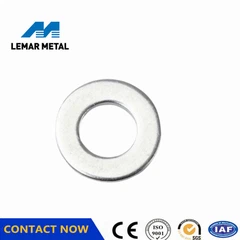
As a leading supplier of spring washers, we offer a wide range of products to meet the diverse needs of our customers. Our product portfolio includes Stainless Steel Spring Washers, B Spring Lock Washer, and Stainless Steel Spring Lock Washer.
Our spring washers are made from high-quality materials and are designed to provide reliable performance and long service life. We offer a variety of sizes and spring rates to meet the specific requirements of your application. Whether you need a small batch for a prototype or a large quantity for a production run, we can provide you with the right spring washer solution.
Contact Us for Your Spring Washer Needs
If you have any questions about spring washers or need help choosing the right product for your application, please don't hesitate to contact us. Our team of experts is available to provide you with technical support and guidance. We are committed to providing our customers with the highest quality products and services, and we look forward to working with you.
Send Inquiry