

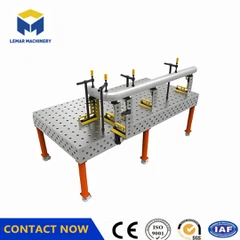


How to ensure the precision of 3D welding tables?
Apr 20, 2026
Leave a message
1. Materials and Heat Treatment Process
HT300 gray cast iron or Q345 low-alloy steel is used as the base material, offering high tensile strength and excellent wear resistance.
After high-temperature aging at 550℃ followed by 6 months of natural aging, the residual stress removal rate is ≥85%, effectively preventing deformation during use and maintaining long-term stability.
2. High-Precision Machining and Structural Design
The table surface undergoes three ultra-precision grinding processes, achieving a surface roughness of Ra1.6μm and a flatness error ≤0.05mm/m², far exceeding the national standard GB/T 22095-2008.
T-slots or positioning hole arrays are precision milled using a CNC machining center, with hole spacing accuracy controlled within ±0.05mm, ensuring a tight fit between the fixture modules.
3. Modular System Precision Coordination
Standard modules (square boxes, angle rulers, support blocks, etc.) undergo ultra-precision grinding before leaving the factory, with a perpendicularity error ≤0.02mm/m and a flatness error ≤0.03mm/m.
Modules are connected via quick-locking pins and T-slots, with a splicing gap ≤0.03mm and an overall fixture assembly error ≤±0.08mm, meeting the overall accuracy requirement of ±0.1mm.
4. Precision Assurance During Use and Maintenance
The three-point positioning method reduces workpiece displacement. The positioning error formula is: Δt ≤ α/√α (α is the tolerance, α is the number of positioning points), improving the consistency of repeated positioning.
Regular precision calibration is recommended. It is suggested to use a coordinate measuring machine to check the platform flatness and hole accuracy quarterly and correct deviations promptly.
By using a 3D vision camera or laser sensor to achieve closed-loop control, the welding torch position can be monitored and adjusted in real time, and the deviation can be controlled within ±0.1mm.

Send Inquiry