

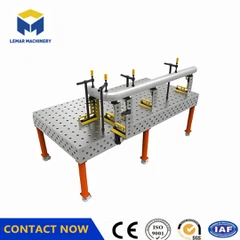









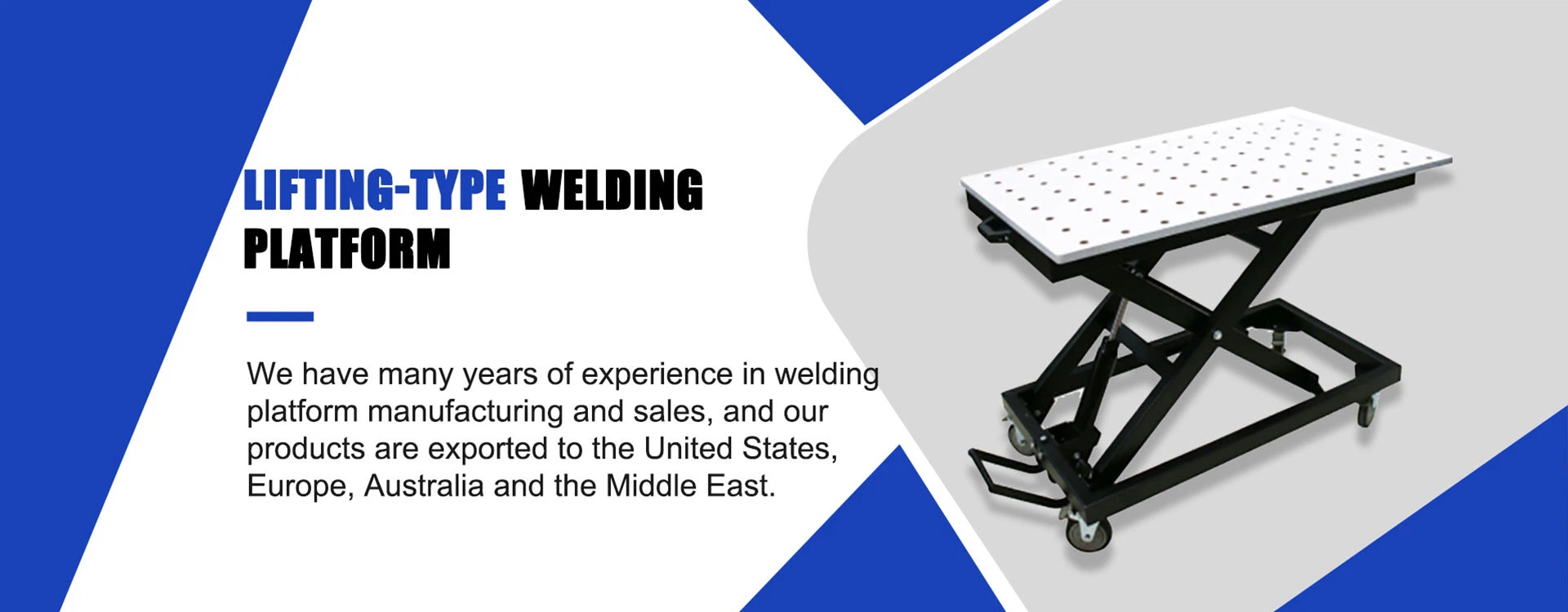
How to verify a 3D welding table after leveling/calibration
Jun 26, 2026
Leave a message
Step 1: Re-verification of Core Accuracy (Baseline Validation)
Re-test all key indicators against factory accuracy standards to confirm that the correction meets requirements:
1. Flatness: Using a frame-type spirit level and feeler gauges, measure points at 500mm intervals along the X and Y axes; the result is acceptable if maximum deformation is ≤0.05mm/1000mm (or ≤0.10mm/1000mm for general-purpose applications). For high-precision requirements, use a laser scanner to scan the entire table surface and confirm that all deviations fall within tolerance limits.
2. Hole Position Accuracy: Re-measure the center-to-center distances of all locating holes; the result is acceptable if deviations are within ±0.05mm. Additionally, test-insert all locating locking pins; compliance is confirmed if they insert smoothly without binding or noticeable gaps.
3. Geometric Tolerances: Check the perpendicularity between the side faces and the top surface, as well as the overall twist of the table; the result is acceptable if deviations return to within factory standard ranges.
Step 2: Trial Production Verification (Actual Performance Validation)
After passing the accuracy re-test, conduct trial machining/welding to verify actual performance:
Select 1–3 typical workpieces from your standard production run and clamp/weld them using routine processes. After welding, inspect the workpieces for dimensional and geometric tolerances; if all indicators meet your production requirements, the correction is effective. If workpieces consistently exceed tolerances, the correction accuracy is insufficient and requires further fine-tuning.
Step 3: Stability Check (Long-term Reliability Validation)
Allow the table to sit for 7–15 days after correction (7 days for tables that have undergone stress-relief tempering, 15 days for those that have not) and re-test core accuracy: if the accuracy variation is ≤0.01mm/1000mm, stability meets standards and no significant "spring-back" will occur. If the variation exceeds 0.02mm, it indicates that residual stress has not been fully released; the table must be left to stabilize further before re-testing.

Send Inquiry