

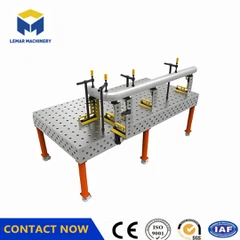


How to determine if a 3D welding table requires leveling or adjustment.
Jun 24, 2026
Leave a message
Step 1: Observe visual indicators to quickly rule out cases where correction is unnecessary.
Correction is likely not required if the following issues are absent:
1. Locating pins insert smoothly into all locating holes; no binding or positioning misalignment occurs during workpiece clamping.
2. The welding table sits stably; after adjusting the support feet, no obvious warping or tilting is visible to the naked eye.
3. After processing standard workpieces, finished dimensions meet tolerance requirements; there are no batch dimensional deviations.
If any of the following occur-"pins won't insert/clamping misalignment," "table surface visibly uneven," or "batch dimensional deviations"-further accuracy testing is required.
Step 2: Measure accuracy data and compare against standards.
Measure key accuracy parameters; correction is required if any of the following limits are exceeded:
1. Flatness: Maximum deformation > 0.03mm/1000mm (exceeds factory tolerance).
2. Hole-to-hole spacing: Deviation in center-to-center distance between any locating holes > ±0.05mm (causing inaccurate clamping/positioning).
3. Perpendicularity/Twist: Perpendicularity deviation between side and top surfaces > 0.05mm/200mm, or diagonal gap difference > 0.1mm.
Step 3: Make a final determination based on specific usage requirements.
1. High welding accuracy requirements (e.g., construction machinery, precision structural components): Correction is required if accuracy exceeds factory tolerances to prevent workpiece scrapping.
2. General/rough welding with low accuracy requirements: Correction is not required if deformation is ≤ 0.1mm/1000mm and clamping is unaffected; however, correction is still required if deformation exceeds 0.1mm/1000mm.
3. Structural cracks present: Replacement is required; correction is not an option.

Send Inquiry