

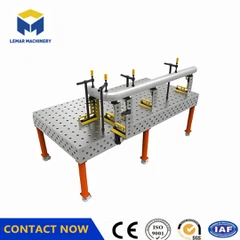

What methods can be used to correct moderate deformation in 3D welding tables?
Jun 19, 2026
Leave a message
I. Flame Straightening (Most common method; suitable for various types of deformation; offers stable results)
Flame straightening is cost-effective and flexible for correcting moderate deformation; the heating method is simply adjusted based on the type of deformation:
1. Surface Warping/Wavy Deformation: Locate the peaks of the raised areas and apply spot heating with a diameter of 50–90 mm (adjust the size based on plate thickness; thicker plates require larger spots). Maintain the heating temperature between 600°C and 700°C. After heating, lightly hammer the heated area; natural cooling causes contraction, which flattens the deformation. Heat multiple peaks sequentially rather than heating a large area all at once to avoid inducing new deformation.
2. Bending/Angular Deformation: Apply linear heating to the convex (raised) side of the deformation, maintaining a temperature of 600–800°C. Two parallel heating strips can be heated simultaneously to balance contraction stress and prevent new twisting.
3. Flange Angular Deformation: Apply longitudinal linear heating along the outer side of the weld seam. Keep the temperature below 650°C and ensure the heated area does not extend beyond the weld toe; allow for natural cooling-do not use water cooling.
⚠️ Note: Cast iron welding tables must cool slowly and naturally after straightening; water cooling is strictly prohibited, as it can cause the material to crack. Ensure the heating location is correct-apply heat to the convex side; heating the opposite side will worsen the deformation.
II. Mechanical Straightening (Suitable for small, regularly shaped components with moderate deformation)
This method requires no heating and does not alter material properties; it is suitable for moderate warping on regular, flat surfaces:
1. Secure the welding table firmly onto the bed of a large press. After locating the raised deformation area, slowly apply counter-pressure. Maintain the pressure for 10–15 minutes to allow the material to undergo sufficient plastic deformation. Release the pressure and re-check accuracy; if deviations persist, adjust the pressure and repeat the process until flatness is restored to within acceptable limits.
2. For small, localized areas of moderate deformation, a hand hammer and a flat anvil can be used. Lightly hammer and work the raised area to gradually stretch the material and correct the deformation.
3. After straightening, it is recommended to perform a low-temperature tempering process (holding at 300°C for 30 minutes) to relieve any new internal stresses generated during straightening and prevent the deformation from springing back later.

Send Inquiry