

How does a modular steel welding table affect the quality of welds?
Nov 09, 2026
Leave a message
Hey fellow welders, fabricators, and anyone who's ever stared at a lopsided weld and thought, "There's gotta be a better way" - let's talk modular steel welding tables. I've been selling these for years, and hands down, the question I get asked most isn't about price or size - it's about how they actually impact weld quality. Spoiler: it's way more than just a flat surface to set your pieces on. Let's break this down like we're huddled around a shop floor coffee pot, no boring jargon, just real talk.
First, let's get one thing straight: a cheap, clunky welding table you bolt together from random steel plates? That's a headache waiting for a weld defect. Modular tables - the ones made from interlocking steel components, precise holes, and adjustable fixtures - are built to fix the small, annoying issues that ruin welds every single day. Let's start with the basics: stability. If your table wiggles when you tack a piece, or the surface flexes mid-weld, your joint's gonna shift. Even a tiny shift - like 0.5mm - can throw off your fit-up, cause uneven heat distribution, and lead to cracks or incomplete fusion. Modular steel tables, especially the heavy-duty ones, are engineered to keep that surface rock solid. No movement, no surprises. That's non-negotiable for good welds.
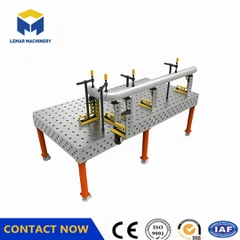
Wait, but not all modular tables are the same. You've got options, right? If you're working on big, complex assemblies, a 3D Fixture Welding Table is a game-changer. Let me tell you - traditional tables make you improvise clamps, run out to the hardware store for random brackets, and spend more time adjusting than welding. With a 3D modular setup, all those pre-planned holes are standardized, so you can lock your parts into place in minutes, not hours. That means less time fumbling with fixturing and more time welding with consistent, repeatable alignment. For a lot of my customers, that cut their prep time by 30% overnight - and when you're not rushing to get your clamps right, your welds are cleaner.
Another big one: fit-up consistency. Fit-up is just the gap between two pieces you're welding, and if that gap isn't the same every time, your weld quality varies. Let's use the D28 Welding Table as an example. The D28 refers to the 28mm precision holes that are spaced perfectly across the table - no measuring, no guessing. Whether you're welding a small bracket or a large frame, you can reuse the same fixtures, set the same gaps, and get the same alignment every single time. I've got a customer who builds custom metal railings - he used to rework 1 out of 5 railings because the joints were off. Switch to a D28 table, and now that number's down to almost zero. That's the power of consistent, modular fixturing.
Heat management is another thing welders don't talk about enough, but it's huge for quality. When you weld, you're melting metal, and if your workbench is a hot, uneven surface, that heat can sink unevenly into your parts, leading to distortion. Modular steel tables - especially the nitrided ones - have better heat dissipation than regular steel tables. Nitrided Welding Fixture Tables, for example, have a surface that's hardened and resists warping from repeated heat exposure. I used to sell regular mild steel tables, and the guys who bought them would have to grind down warped table surfaces every few months. The nitrided ones? They hold their shape for years. Less table warping means less part distortion, and that's how you get a weld that holds tight, not one that twists and pulls apart later.


Wait, let's get specific about distortion. It's the arch-nemesis of any welder. When you weld, the heat makes metal expand, then contract as it cools. On a flimsy table, your parts can move with that expansion, leading to a finished assembly that's bent or twisted. On a modular table, you can clamp your parts firmly before you even start welding, so when the metal tries to move, the table holds it in place. Plus, if you're doing a series of welds, adjustable fixtures (that's the Adjustable 3D Welding Table) let you support your parts at multiple points, so there's no "give" where you don't want it. I had a guy who welds steel brackets for trailers tell me before he got his adjustable table, half his batches came back with warped brackets. Now he cranks out 200 a week, and only 1 or 2 need rework. That's a direct line between the table and the quality of his end product.
Let's not forget about precision for intricate work. If you're welding custom parts, or items that need to fit together later - like machine frames or architectural metalwork - accuracy is everything. The 3D Welding Platform D28 has a surface tolerance of like 0.05mm, which is tighter than a human hair. When you lock a part into that, you don't have to guess if it's straight. No more "I think it's square" - you can confirm with the table's markings, and your weld will be symmetric every time. I've seen so many shops upgrade from cheap flat plates to these and their weld defect rates drop by 40% or more. It's not magic; it's just not cutting corners on precision.
Now, let's address a common myth: some welders think modular tables are only for big jobs, or they're too expensive. But here's the thing - the rework you avoid, the time you save, and the consistent quality you get actually saves you money in the long run. I've got a small shop guy who bought a compact modular table last year, and he says he's already made back the cost in less rework fees and faster turnarounds. For shops that are growing, being able to reuse fixtures and adjust the table as needed means you don't have to buy new equipment every time you take on a new project. That's the beauty of modularity - it scales with you.
Wait, what about when you're working with different materials? Some welders work with steel, some with aluminum, some with stainless. Modular steel tables can handle all of that, right? The key is the surface. Nitrided tables, for example, are also corrosion-resistant, so if you're working with stainless and don't want cross-contamination, you can keep that surface clean and it won't react. I've had customers who switch between steel and aluminum all the time, and the modular setup lets them switch fixtures without messing up the table surface. No more old weld spatter ruining the alignment holes - easy to clean, easy to maintain.
Let's wrap this up with real world stuff. Last month, I visited a shop that was using a regular table for heavy structural welding. They were having issues with welds cracking because of uneven fit-up and table flex. I recommended they look at a sturdy modular table, specifically pointing them to the 3D Fixture Welding Table for their large assemblies. A week later, they texted me saying their crack rate went from 12% to 2% in just one week. That's not a fluke - that's the table doing its job, holding their parts in the right place, letting them weld consistently.
So, to answer the original question: how does a modular steel welding table affect weld quality? It's not one big thing, it's a bunch of small ones: stability, precise alignment, consistent fit-up, better heat management, less distortion, and reduced rework. All of those add up to cleaner, stronger, more consistent welds that last.
If you're tired of reworking welds, fighting with flimsy fixturing, and wondering why your perfect welds on paper turn out wonky in real life, it might be time to upgrade your table. I can help you pick the right one - whether you're a small hobbyist or a big fabrication shop. Hit me up to chat about what you're working on, and we can find a modular setup that fits your needs, no nonsense, no jargon, just the right equipment for better welds.
Send Inquiry