

What is the size range of 3D precision welding tables?
Nov 14, 2026
Leave a message
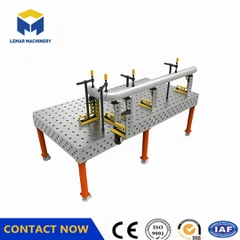
If you're in the welding game, you've probably heard the hype around 3D precision welding tables-those modular, grid-laced workhorses that let you clamp, adjust, and lock parts into place way faster than a basic flat table. But one question comes up nonstop when I'm talking to fellow welders, fabricators, or even small shop owners just starting out: what's the actual size range I should be looking at? Spoiler: it's not one-size-fits-all. As a supplier of these tables for years, I've seen people way overbuy or underspend because they didn't know the full scope of sizes out there. Let's break it down, no confusing jargon, just the straight stuff.
First, let's get a quick baseline: 3D precision welding tables aren't your old-school, solid steel workbench. They have a regular grid of precision holes (usually 16mm or 28mm diameter, depending on the model) spaced either 100mm or 50mm apart-more on that later, but that spacing actually ties directly to size. The size range depends on two big things: what you're using the table for, and what material it's made of. Wait, yeah, material matters for size too-like cast iron vs. steel plates, those have different weight limits that shape how big they can get without warping.
Let's start with the smallest end first. If you're a hobbyist, a one-person small shop doing repair work, or even a maker doing custom metal art, you don't need a giant table. Most mini 3D tables clock in between 600x600mm (that's roughly 2x2 feet) and 900x900mm (3x3 feet). I've sold a ton of these to guys working on small brackets, automotive trim parts, or even jewelry-sized metal work. They're light enough to move around if needed, easy to store in a tight corner, and still have enough hole spacing to clamp small parts securely. Wait, but even these small tables aren't flimsy-they're precision-machined, so you don't get wobbly clamps or parts shifting mid-weld.
Next, the mid-range, which is the sweet spot for most small to mid-sized fabrication shops. This is where you'll find most of the tables we ship out regularly. Sizes here run from 1200x1200mm (4x4 feet) up to 2400x1200mm (8x4 feet) or 2400x1500mm (8x5 feet). Why is this the sweet spot? It's big enough to handle most common jobs: medium-sized metal cabinets, farm equipment parts, small vehicle frames, even batches of 3-4 small components at once. The hole spacing on these mid-sized tables is usually 100mm, which is the industry standard for balancing flexibility and stability. If you're running a shop that does a mix of custom orders and production runs, this range is where you're most likely to fit. I always point folks to our Precision 3D Welding Tables here if they're in this size bracket-they're machined to within 0.05mm accuracy, so parts line up perfectly every single time. No more re-aligning mid-job, which saves so much time.
Now, the large end of the spectrum-this is for heavy-duty, high-volume fabrication. Think shipyards, large equipment manufacturers, car body shops, or shops that work on full frames or large structural steel parts. Tables here go up to 3000x1500mm (10x5 feet), 3600x1500mm (12x5 feet), and even some custom sizes up to 4000x2000mm (13x7 feet) for really big jobs. Wait, but can a table that big actually stay accurate? That's a common question I get. The key here is material and construction: larger tables are usually made from thicker steel plates (12mm or 15mm, compared to 8mm for mid-sized) or high-density cast iron, which won't warp under the weight of heavy parts like 500kg (1100lb) steel beams. For these heavy-duty needs, our 3D Welding Cast Iron Tables are a top pick-cast iron doesn't flex, so your clamps and parts stay locked in place, even when you're welding thick steel that generates a lot of heat.


Wait, hold on-size isn't just about length and width, right? There's a thing people forget: the weight capacity. But weight capacity ties directly to size, so it's worth mentioning in this range. A 600x600mm mini table might hold up to 500kg, while a 3000x1500mm large table can hold 2000kg or more. That's why you can't just grab a big table because it looks big-you need to make sure it can handle the parts you're working with.
Let me also clarify a common mix-up: 3D tables vs. other welding tables. A lot of folks come in asking about our Metal Fab Welding Table, and wonder how that fits into the size range. The Metal Fab line is specifically for general fabrication, so their sizes fall right into that mid-range sweet spot I talked about-1200x1200mm up to 2400x1500mm. They're a bit more budget-friendly than the cast iron heavy-duty ones, perfect if you're not doing 10-hour welds on massive beams every day.
Another category that bridges mid and large is the Universal Welding Table. These are designed to be modular, so you can add extensions if your needs grow. Their base sizes start at 1200x1200mm, and you can snap on extra 600x1200mm sections to make it up to 3000x1200mm without replacing the whole table. That's a huge win for shops that want to scale-no need to buy a whole new table when you start taking bigger jobs.
Wait, what about the hole pattern? Does that affect size? Yeah, a little. Most 3D tables use either 16mm or 28mm holes, with 100mm or 50mm spacing. The 50mm spaced tables are usually smaller-around 900x900mm or 1200x1200mm-because the denser hole pattern is for smaller, more precise parts. The 100mm spaced holes are more common on larger tables, since they give you more room for big clamps and heavy parts without cluttering the surface. That's something to keep in mind when you're picking size: if you do super fine work, you might need a smaller table with 50mm spacing, even if your main jobs are medium-sized.
Let's talk real-world examples to make this make sense. I had a customer last year who runs a custom motorcycle shop-he was working on bike frames that are about 1800mm (6 feet) long. He got a 2400x1200mm mid-sized table, perfect: he could fit the whole frame, plus the engine mounts and handlebars, all in one go. Another customer is a farm equipment repair shop-they work on broken tractor frames that are up to 3000mm (10 feet) long, so they went with a 3600x1500mm large cast iron table, and it's been holding up great for two years now. Even a hobbyist I sold a 900x900mm table to uses it for custom metal art, and he says it's more than enough for his small sculptures and brackets.
A common mistake I see is people buying the largest table they can afford, even if their jobs are mostly small. Why is that a mistake? A big table takes up way more floor space-something small shops or home garages don't have a lot of. Also, a larger table is heavier, so you might need a stronger floor or lifting equipment to move it if you need to rearrange your shop. On the flip side, buying a tiny mini table if you occasionally work on medium parts means you'll have to re-clamp and move parts a lot, which wastes time and can lead to alignment errors.
So to wrap up the size range, here's a quick cheat sheet:
- Mini: 600x600mm to 900x900mm → hobbyists, small repair, custom small parts
- Mid: 1200x1200mm to 2400x1500mm → small to mid shops, general metal fab, most common use case
- Large: 3000x1500mm to 4000x2000mm → heavy industry, large equipment, full frames
Wait, also, custom sizes are an option! I know not everyone fits into those standard ranges. If you have a unique job-like building large shipping container frames, or small aerospace parts-we can make a table to your exact dimensions. That's one of the perks of working directly with a supplier, right? No forcing you to pick a one-size-fits-all model.
If you're still not sure where you fall, think about two things: the biggest part you usually weld, and how much floor space you have. Measure your largest work piece, add 150mm (6 inches) on each side-give yourself room to add clamps without hitting the edge of the table. Then look at your shop floor: if you only have a 3x4 foot corner, you're not fitting an 8x4 foot table. If you have a big open space and work on 10-foot parts, go large.
Oh, and let's not forget accessories! Whatever size table you pick, you can add fixtures like clamps, supports, and angle plates to make it work for your specific jobs. Our 3D Welding Fixture Table line has all those add-ons, sized to fit the table, so you don't have to hunt for random clamps that don't line up right.
At the end of the day, the right size isn't just about numbers-it's about matching your table to your work. Too small, and you're fighting the table every day; too big, and you're wasting space and money. That's why I always tell folks to reach out if they have questions, instead of guessing wrong. Whether you're a hobbyist just starting out or a big shop needing heavy gear, we've got sizes to fit every need. If you want to chat through your specific job requirements, get pricing, or see how a certain size would work for you, we're here to help with no pressure. Don't hesitate to reach out to start your 3D precision welding table journey-we can make sure you get the right size for your setup.
Send Inquiry