

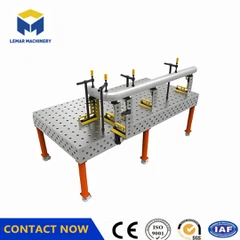
How to Correct Deformation in 3D Welding Tables After Heat Treatment
Jun 10, 2026
Leave a message
1. Minor deformation (deformation ≤ 0.03mm/1000mm): Cold straightening method
This type of deformation involves minimal dimensional deviation and can be resolved through mechanical cold straightening: secure the welding table to a reference platform, locate the raised deformation area, slowly apply counter-pressure using a press, maintain the pressure for approximately 10 minutes, and then release it. For small, localized deformations, a hand hammer and a flat anvil can be used to gently hammer and work the raised area, utilizing material ductility to eliminate the deformation. After straightening, perform low-temperature tempering at 300°C to relieve stresses induced during the process and prevent subsequent spring-back or warping.
2. Moderate deformation (0.03mm/1000mm < deformation ≤ 0.10mm/1000mm): Flame straightening method
This is the most common straightening method in production; it utilizes the thermal expansion and contraction of metal to counteract deformation. The procedure must be adjusted according to the specific type of deformation:
For bending or angular deformation: Apply linear heating to the convex (raised) side of the deformation. Strictly control the temperature between 600°C and 800°C; simultaneous heating using two parallel heating bands may be employed to prevent new twisting.
For planar buckling (wavy deformation): Apply spot heating at the peaks of the waves. Control the heating spot diameter between 50mm and 90mm (adjusted based on plate thickness). Once the temperature reaches 600°C–700°C, gently hammer the heated area; natural cooling causes contraction, which flattens the deformation.
For flange angular deformation: Apply longitudinal linear heating to the outer side of the weld seam. Keep the temperature below 650°C and allow for natural cooling; do not use water cooling.
⚠️ Cast iron welding tables must cool slowly after straightening; water cooling is strictly prohibited to avoid cracking. It is recommended that this process be performed by professional operators to prevent improper heating from causing even greater deformation.
3. Complex, severe deformation (deformation > 0.10 mm/1000 mm): Combined correction method
A combined approach-using mechanical correction for initial adjustment followed by flame correction for fine-tuning-is preferred. First, employ a press or straightening machine to correct major dimensional deviations and bring the deformation within a manageable range; then, use flame correction to address any remaining localized, minor deformations. Upon completion, perform low-temperature stress-relief tempering to eliminate newly induced internal stresses and ensure long-term dimensional stability.
If the deformation is extreme-making it difficult to restore precision to acceptable standards-and the cost of correction approaches that of a new unit, direct replacement of the welding table is recommended.

Send Inquiry