

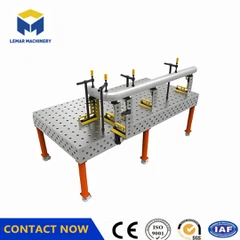


How to Correct Heat Treatment Deformation in 3D Welding Tables
Jun 05, 2026
Leave a message
I. Mechanical Straightening: Suitable for mild to moderate planar warping and bending deformation.
This method counteracts deformation by applying external force without altering material properties, and it involves a lower operational threshold. For planar warping: Secure the workpiece firmly onto the bed of a large press; after locating the raised (convex) area, slowly apply counter-pressure to that spot, hold the pressure for 10–15 minutes, and then release it. Re-measure flatness and incrementally adjust the pressure until the required precision is achieved. For smaller deformations, a hand hammer and flat anvil can be used; lightly hammering and rolling the raised area stretches the material to correct the shape. For bending or angular deformation: Use a straightening machine or hydraulic jack to apply continuous force to the convex side of the bend. Adjust the pressure based on the extent of deformation, hold the pressure, re-measure, and gradually correct the part to within standard tolerances.
Note: Mechanical straightening leaves behind some residual internal stress. It is recommended to perform a low-temperature stress-relief tempering process after straightening-soaking at 300°C for 30 minutes followed by furnace cooling-to prevent future deformation.
II. Flame Straightening: Suitable for moderate to severe deformation; applicable to both cast iron and steel structures.
This method utilizes the thermal expansion and contraction properties of metal, counteracting existing deformation through localized heating and subsequent cooling-induced shrinkage. It is the most common straightening technique in production, with specific operations tailored to the type of deformation: For bending or angular deformation, apply linear heating to the convex side, strictly controlling the temperature between 600°C and 800°C; simultaneous heating along two parallel lines may be used to prevent new twisting. For planar "wavy" deformation, apply spot heating at the wave crests combined with light hammering; the heated spot diameter should be 50–90 mm (adjusted based on plate thickness). Once the temperature reaches 600–700°C, lightly hammer the heated area; cooling shrinkage will then flatten the surface. For flange angular deformation, apply longitudinal linear heating along the outer side of the weld; keep the temperature below 650°C and restrict the heating zone to the weld toe area; allow for natural cooling rather than water cooling. Note: Flame straightening requires a high level of operational expertise. Cast iron welding tables must be allowed to cool slowly after the process; water cooling is strictly prohibited to prevent material cracking. Incorrect heating placement or excessive temperatures can lead to further deformation; therefore, the procedure must be performed by qualified professionals.
III. Combined Straightening: Suitable for complex, severe deformation
For welding tables exhibiting significant deformation or complex geometries, a combined approach is recommended: initial adjustment via mechanical straightening followed by fine-tuning via flame straightening. Mechanical straightening corrects major dimensional deviations, while flame straightening addresses localized, minor distortions. Upon completion, a low-temperature stress-relief treatment is applied to eliminate stresses induced during the straightening process, ensuring long-term dimensional stability.
If the deformation exceeds 0.1 mm per 1,000 mm, restoring precision to acceptable levels is difficult, and the cost of straightening approaches that of a new unit; in such cases, direct replacement is recommended.

Send Inquiry