

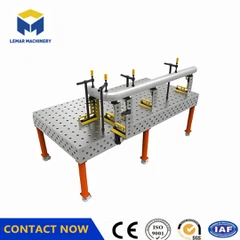






How to determine if the flatness error of a 3D welding table exceeds the standard?
Feb 09, 2026
Leave a message
I. Core Judgment Methods
1. Professional Instrument Measurement: Use an electronic level, autocollimator, or laser interferometer to measure the elevation by laying out points in a grid (e.g., 5×5 or 7×7 points).
2. Data Evaluation: Use the minimum area method or diagonal method to calculate the maximum deviation between the measured value and the ideal plane.
3. Threshold Comparison: Compare the results with industry-standard values of 0.1mm/1000mm (industrial grade) or 0.05mm/1000mm (high precision).
II. Quick On-Site Judgment (Auxiliary Reference)
1. Level Check: Move the level along the longitudinal and transverse directions of the table surface and observe the bubble offset. If the deviation at a single point is significant, professional verification is required.
2. Straightedge and Feeler Gauge Method: Place a straightedge on the table surface and use a feeler gauge to measure the gap. This is suitable for preliminary qualitative judgment. III. Key Precautions
1. Stable Environment: Measurements must be conducted in a vibration-free, temperature-stable environment.
2. Multi-point Assessment: Avoid measuring only the center; cover the diagonals and edge areas.
3. Report as the Standard: The final judgment is based on a professional calibration report (such as CMM data).
IV. Handling of Errors: If the error exceeds the standard, contact a professional organization for scraping repair or laser leveling compensation. Recalibrate after repair.

Send Inquiry