

Are there any high precision welding tables with integrated lighting?
Nov 08, 2026
Leave a message
If you're in high-precision welding, you know the tiny details make or break a project-even the ones you don't see at first glance. I've been in the welding table supply game for years, and the question I get more than any other lately is "Are there high-precision welding tables with integrated lighting?" Let's cut through the noise: yes, they exist, but most off-the-shelf options fall short when it comes to both precision and lighting that actually works for tight welds. Here's what you need to know, straight from someone who's installed, tested, and tweaked tables for shops ranging from small custom fabricators to large aerospace part facilities.
First, let's talk about why lighting matters for high-precision welding. When you're working on 0.5mm-thick stainless steel, or a small aerospace bracket with 0.3mm weld gaps, glare, shadows, or inconsistent light can make you misalign your torch, skip a spot, or end up with a weld that's just a hair off. Bad lighting doesn't just slow you down-it causes rework, which kills profit. Standard welding tables come with a clamp and a surface, but they leave you hanging when you need to see every little detail. That's where integrated lighting becomes a game-changer, but not all integrated lights are created equal.
Let's break down what makes a high-precision welding table with integrated lighting actually useful (not just a marketing gimmick). First, the table itself has to be high-precision-no wobbly surfaces, no uneven holes, no tolerance gaps bigger than 0.02mm. If your table isn't accurate, adding lighting won't fix crooked welds. Then, the lighting needs to be task-specific: it can't be too bright (it causes glare on metal surfaces), can't be too dim (you'll squint and miss details), needs to eliminate shadows from clamps or fixtures, and has to last-welding environments get hot, spatter is everywhere, so cheap lights die fast.
A lot of shops I talk to tried adding clamp-on work lights to their existing tables. Those things are garbage-they swing out of alignment, get knocked off by spatter, and create weird shadows right where you need to see. Integrated lights, on the other hand, are built into the table frame or even the work surface perimeter, which means they stay put, direct light exactly where you're welding, and don't block your access to the workspace.
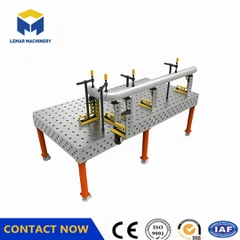
Now, let's get into the specific tables we make, since that's what I know best. Wait-no, don't just take our word for it, but let's use concrete examples. Our D28 Series Steel Welding Table? Yeah, that's a workhorse for high-precision work. It has a laser-accurate work surface with 28mm hole spacing (the industry standard for modular fixtures) and a built-in integrated LED lighting system that runs along the table's edge. The LEDs are cool to the touch, so no risk of melting if a spatter spot lands on them, and they produce 5000K neutral light-same as natural daylight, so you see weld color correctly (super important for gas welds where color indicates proper penetration). We didn't just slap lights on it; we positioned them so they eliminate shadows from clamps and torches. I've seen guys use this table to weld tiny medical device parts where the weld is so small you can barely see it with the naked eye, and the light makes it easy.
If you're working on heavier fabrication projects, our 3D Flexible Welding Table might be more your speed. It's modular, so you can rearrange fixtures and clamps on the fly, which is perfect for small-batch custom welding jobs. We offer the integrated lighting as an add-on for this model too, and the best part is that the lighting is adjustable-you can swivel the light heads to aim exactly at your weld joint, no matter where it is on the table. A few months back, a guy from a farm equipment shop bought one of these for welding custom tractor brackets; he told me he cut his setup time by 20% because he didn't have to mess with extra lights, and his rework went from 8% to less than 2%. That's the kind of win we care about.
Wait, but what if you need even more precision? Our Fixture Tables For Welding are designed specifically for projects where consistency is key-think automotive components or structural steel parts with tight tolerance requirements. We pair these with a recessed integrated lighting system that sits flush with the table frame, so there's no bump in the surface to get in the way of your fixtures. The LEDs here are also protected with a shatterproof lens, which is a must if you're doing a lot of MIG welding where spatter flies. I've seen shops use these tables to run 50 identical parts a day, and the welds are consistent across every single one-partly because the table is accurate, partly because the light lets them check each weld as they go without moving the part.
Another option for guys who prefer cast iron? Our 3D Welding Cast Iron Platform. Cast iron has better heat dissipation than steel, which is a plus if you're doing long welds that heat up the work piece. We offer integrated lighting for this model too, and the light system is sealed to keep out weld fumes and dust-so it lasts way longer than open-style lights. A guy from a art fabrication shop used this table to weld large custom metal sculptures; he said the cast iron's stability and the integrated light let him do precise welds on curved, complex shapes without worrying about the table shifting or missing a spot because of bad lighting.
Then there's our Fabrication Welding Fixture Table, which is made for shops that do a mix of high-precision small parts and medium-sized fabrication runs. The integrated lighting here is dimmable, which is a huge feature-you can crank it up for tiny, detailed welds and dim it a bit if you're working on larger parts where you don't need maximum brightness. I talked to a welder at a marine parts shop recently who uses this table for welding small boat components; he said being able to adjust the light takes the strain off his eyes during 8-hour shifts, and he's had fewer errors because he's not squinting.
But let's be real-no table is perfect, even with integrated lighting. I've had customers come back and say they bought a cheap imported table with "integrated lighting" just to find out the holes are off by 0.1mm, which makes it impossible to align fixtures correctly. Or the lights are cheap LEDs that burn out in 3 months because they get too hot from welding. So when you're shopping, don't just look for "high-precision" and "integrated lighting"-check these four things:
First, the table's actual precision tolerance. Good tables will have a tolerance of ±0.02mm or better across the entire work surface. If it says "high precision" but doesn't list the tolerance, skip it. Second, the lighting's color temperature. 5000K is ideal for welding-anything lower (warmer, yellow) makes it hard to see weld color, anything higher (bluer) causes glare. Third, the lighting's durability. It should be sealed, shatterproof, and rated for use in high-heat, spatter-heavy environments. Fourth, how the lighting is positioned. It should be along the edges or recessed, not mounted above the center, so it doesn't cast shadows from your torch or clamps.
Another thing to consider: are you doing robotic welding or manual? If you're using a welding robot, integrated lighting is even more important because robots follow pre-programmed paths-shadows or uneven light can make the robot misalign and mess up the weld. All the tables I mentioned above work with robotic setups too; the integrated lighting is consistent, so the robot's camera (if you have one) can pick up the weld joint every time without issues.
I get it-adding lighting to a high-precision table sounds like an extra cost, but let's do the math. If a welder saves 10 minutes per weld because they don't have to adjust a separate work light, that's 40 minutes a day back in their schedule. Less rework means less material waste, which adds up. And no more straining your eyes for 8 hours a day-welders get less tired, which means fewer mistakes at the end of the shift. I've seen shops that upgraded to our tables with integrated lighting and increased their output by 15% without hiring more people.
Wait, but what if you already have a table you like and just want to add lighting? We also sell after-market integrated lighting kits that work with our tables, and some compatible ones for other brands, though I can't speak to how well they work on non-our tables. But if you're already shopping for a new high-precision table, it's way easier and more reliable to get the lighting built in.
Let's talk about a common myth: some people think integrated lighting adds too much bulk to the table, making it hard to maneuver. Nope-all our tables with integrated lighting are designed so the lights fit neatly into the frame, so the table's footprint is almost the same as a standard high-precision table. We also offer different table sizes, from 1m x 1m for small parts up to 2m x 4m for larger projects, so you can find one that fits your shop space.
Another thing we test for: vibration. Welding shops are loud, vibrate a lot from torches and grinders, and if the lights are mounted poorly, they can flicker or fall out. All our integrated lights are mounted to the table frame with heavy-duty brackets, and we test every table for 48 hours under actual welding conditions to make sure the lights stay stable, no matter how much vibration there is. I've had a shop run a table with integrated lighting 10 hours a day, 5 days a week for 2 years, and they haven't had to replace a single light bulb yet.
If you're still on the fence, let's be honest: the best high-precision welding table with integrated lighting isn't just about the features-it's about how it works for your specific projects. If you're mostly doing small, detailed welds on steel, the D28 Series is perfect. If you need flexible fixtures for custom jobs, go with the 3D Flexible. For heavy-duty consistency, the Fixture Tables For Welding are unbeatable. Cast iron lovers, the 3D Welding Cast Iron Platform is the way to go. And if you need a mix, the Fabrication Welding Fixture Table covers both small parts and medium fabrication.
I've been doing this long enough to know that every shop has different needs, and that's why we don't push one table over another. The key is finding a table that's precise enough for your welds, has lighting that actually helps you see what you're doing, and is built to last in a messy welding shop. No fancy gimmicks, no overpriced add-ons-just a table that does what it's supposed to.
If you're ready to stop wasting time adjusting work lights and dealing with rework from bad lighting, we can help. Just reach out to talk through your specific welding needs, and I or my team can walk you through which table (and lighting setup) works best for you. We've helped everything from 1-person custom shops to Fortune 500 manufacturing facilities upgrade their welding tables, and we're confident we can help yours too. No pressure, no sales pitch fluff-just real advice for real welding jobs.
And one last tip: when you're checking out tables, ask to see a demo. Most reputable suppliers will let you test the table's precision and lighting before you buy, so you can see firsthand how the light eliminates shadows and how accurate the surface is. Don't just take the website's word for it-see it in action.


Send Inquiry