


How are slotted nuts manufactured?
Jan 13, 2026
Leave a message
How are Slotted Nuts Manufactured?
As a reliable slotted nut supplier, I am excited to share with you the detailed manufacturing process of slotted nuts. Slotted nuts are a type of fastener widely used in various industries due to their unique design that allows for the insertion of a cotter pin, which helps prevent the nut from loosening under vibration.
Raw Material Selection
The first step in manufacturing slotted nuts is the careful selection of raw materials. The choice of material depends on the intended application of the slotted nuts. Common materials include carbon steel, stainless steel, and brass.
Carbon steel is a popular choice due to its high strength and relatively low cost. It is suitable for general-purpose applications where corrosion resistance is not a primary concern. Stainless steel, on the other hand, offers excellent corrosion resistance, making it ideal for applications in harsh environments, such as marine or chemical industries. Brass is known for its good machinability and aesthetics, and it is often used in decorative or electrical applications.
Once the appropriate material is selected, the raw material is typically in the form of bars or wires. These bars or wires need to meet strict quality standards in terms of chemical composition and mechanical properties.
Cutting and Forming
After the raw material is selected, it is cut into appropriate lengths. The cutting process can be achieved using various methods, such as sawing, shearing, or machining. The length of the cut pieces is determined based on the size of the slotted nuts to be manufactured.
Next, the cut pieces are formed into the basic shape of the nut. This is usually done through a cold forging process. Cold forging is a cost - effective and efficient method for shaping metal parts. In cold forging, the metal is subjected to high pressure at room temperature, which causes it to flow and take on the desired shape. A series of dies are used to gradually form the nut to the correct dimensions and shape. For example, the first die may form the hexagonal shape of the nut, which is a common shape for slotted nuts.
Threading
Once the basic shape of the nut is formed, the next crucial step is threading. Threading is the process of creating the internal threads that allow the nut to be screwed onto a bolt or a threaded shaft. There are several methods for threading slotted nuts.
One common method is tapping. Tapping involves using a tap, which is a tool with threads on its outside surface, to cut the internal threads in the nut. The tap is rotated into the pre - drilled hole in the nut, gradually cutting the threads as it goes. Another method is thread rolling. In thread rolling, the nut is pressed between two dies with the thread profile on their surfaces. The pressure causes the metal to flow and form the threads. Thread rolling generally results in stronger threads with better fatigue resistance compared to tapping.
Slotting
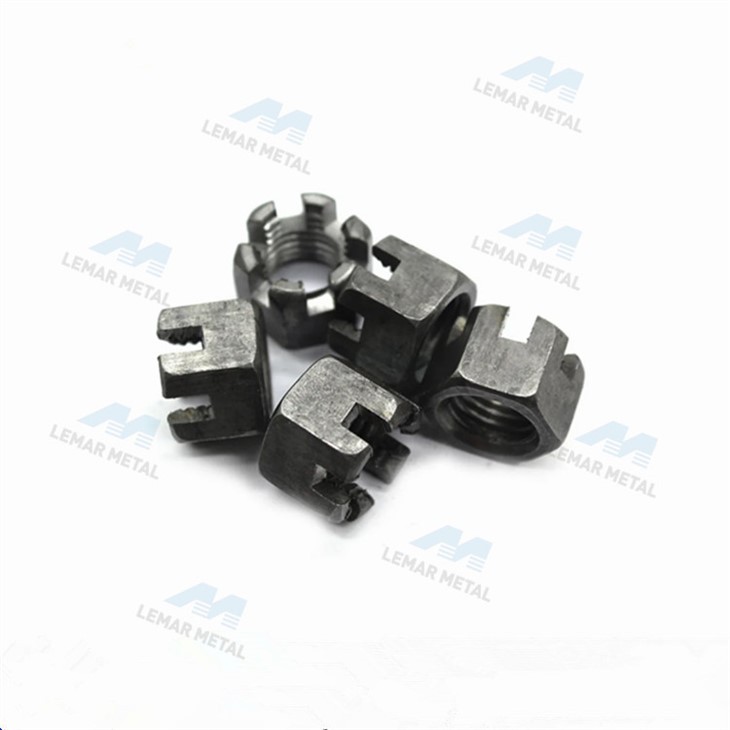
The defining feature of a slotted nut is the slot or slots that are cut into the top of the nut. These slots are used to accommodate a cotter pin or a safety wire, which helps to secure the nut in place.
The slotting process is usually carried out using a milling machine. A milling cutter is used to cut the slots with the required width and depth. The number and position of the slots can vary depending on the design of the slotted nut. For example, some slotted nuts have two slots, while others may have four or more. The accuracy of the slotting process is crucial, as the slots need to be precisely aligned to ensure proper functioning of the cotter pin or safety wire.
Heat Treatment
Heat treatment is often an important step in the manufacturing process of slotted nuts, especially for carbon steel nuts. Heat treatment can significantly improve the mechanical properties of the nuts, such as hardness, strength, and toughness.
The most common heat treatment process for slotted nuts is quenching and tempering. During quenching, the nuts are heated to a high temperature and then rapidly cooled in a quenching medium, such as oil or water. This rapid cooling causes the formation of a hard and brittle structure in the nut. To reduce the brittleness and improve the toughness, the quenched nuts are then tempered at a lower temperature. Tempering helps to relieve the internal stresses created during quenching and makes the nuts more ductile.
Surface Treatment
Surface treatment is carried out to enhance the corrosion resistance and appearance of the slotted nuts. There are several surface treatment options available.
For carbon steel nuts, zinc plating is a commonly used surface treatment. Zinc plating provides a protective layer on the surface of the nut, which helps to prevent rusting. Chromate conversion coating can be applied over the zinc plating to further enhance the corrosion resistance and improve the appearance.
Stainless steel nuts may undergo passivation, which is a process that removes free iron from the surface of the stainless steel and forms a thin, protective oxide layer. This oxide layer helps to prevent corrosion and maintain the integrity of the nut.
Quality Control
Quality control is an essential part of the manufacturing process of slotted nuts. At every stage of production, strict quality checks are carried out to ensure that the nuts meet the required standards and specifications.
Dimensional inspection is one of the most important quality control steps. The dimensions of the slotted nuts, including the outer diameter, inner diameter, height, and thread pitch, are measured using precision measuring tools such as calipers, micrometers, and thread gauges. Any nuts that do not meet the specified dimensions are rejected.
In addition to dimensional inspection, the mechanical properties of the nuts are also tested. This may include hardness testing, tensile strength testing, and torque testing. Hardness testing is used to ensure that the nuts have the appropriate hardness after heat treatment. Tensile strength testing measures the maximum amount of tensile force that the nut can withstand before breaking. Torque testing is used to determine the amount of torque required to tighten the nut onto a bolt, which is an important parameter for ensuring proper fastening.
Types of Slotted Nuts
There are several types of slotted nuts available, each with its own unique features and applications.
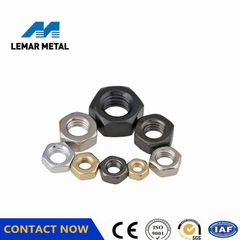
Slotted Round Nuts have a round shape and are often used in applications where a smooth and rounded appearance is desired. They are suitable for use in machinery and equipment where the nut needs to be tightened and secured without causing any sharp edges or protrusions.
Steel Hex Castle Nut is a hexagonal nut with a series of slots on the top. The hexagonal shape allows for easy tightening and loosening using a wrench. Steel hex castle nuts are commonly used in automotive, aerospace, and industrial applications where high strength and reliability are required.
Hex Slotted Castle Nut is similar to the steel hex castle nut but may be made of different materials or have different specifications. It is also widely used in various industries to prevent nuts from loosening under vibration.
Conclusion
In conclusion, the manufacturing process of slotted nuts involves multiple steps, from raw material selection to quality control. Each step is crucial to ensure the production of high - quality slotted nuts that meet the strict requirements of various industries.

If you are in need of slotted nuts for your project, whether it's for industrial machinery, automotive applications, or other fields, we are here to provide you with top - quality products. Our slotted nuts are manufactured using advanced technology and strict quality control measures to ensure reliability and performance. Don't hesitate to contact us for more information about our slotted nuts and to discuss your procurement needs. We look forward to working with you!
References
- "Manufacturing Processes for Engineering Materials" by Serope Kalpakjian and Steven R. Schmid
- "Fasteners and Their Applications" by Alfred J. Schwab
Send Inquiry