

How does the price of a 3D adjustable welding workbench vary by brand?
Oct 28, 2026
Leave a message
If you've ever shopped for a welding workbench, you've probably noticed how big the price gap is between brands-even when products look almost identical at first glance. As someone who's been supplying 3D adjustable welding workbenches for years, I've fielded dozens of questions from welders, fabrication shop owners, and hobbyists asking why one brand charges twice as much as another for a table that seems to do the same thing. The short answer? It's not just about the metal or the holes drilled in the tabletop. Brand pricing for these workbenches depends on a mix of quality, design, customer support, and even who you're buying for. Let's break this down in plain terms, no jargon required.
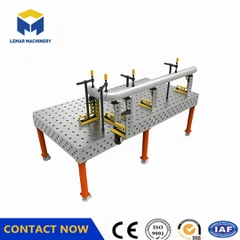
First, let's get one thing straight: not all 3D adjustable welding workbenches are created equal. The most obvious difference is the materials used, but that's where brand starts to play a huge role. Budget brands often cut corners on the base metal-using thinner steel that bends under heavy clamps or high welding currents, or coating it with cheap paint that chips off after a few months of spatter. Mid-range and premium brands, on the other hand, invest in high-grade steel, heat treatment for durability, and industrial-grade anti-spatter coatings. Take, for example, the Metal 3D Welding Table from our line: it's made with 12mm-thick carbon steel, tested to hold up to 2,000 lbs of clamping force without warping. A budget brand might use 8mm steel, which can flex even under lighter loads, leading to sloppy welds and needing replacement sooner. That difference in material quality alone can add 30-50% to the price, which is why premium brands don't just charge for a name-they charge for workbenches that last.
Next up is design and functionality, and this is where brand identity really shines. Entry-level brands often stick to a one-size-fits-all design: a flat tabletop with standard holes, no adjustable supports, and limited compatibility with clamps or fixtures. These are fine for small, simple jobs, but they fall apart when you're working on larger projects, like frames or custom metal fabrications. Mid-range brands add modular features, like interchangeable fixtures and adjustable height legs, that let you adapt the table to different projects. Premium brands take this even further, with precision-engineered hole spacing (usually 100mm or 50mm grids, depending on the model) that makes setting up fixtures faster and more accurate. The Universal Welding Table, for instance, has a multi-hole grid that works with almost every standard clamp and fixture on the market, so you don't have to buy special parts every time you switch projects. That level of design customization and compatibility adds value, and brands that invest in R&D to perfect these features will price accordingly.
Then there's support and warranty, which is where a lot of buyers overlook the long-term cost. Budget brands rarely offer more than a 30-day warranty, and if something breaks, they make you pay for return shipping and replacement parts out of pocket. Mid-range brands usually offer a 1-2 year warranty, with customer support that can help you troubleshoot installation or fixture issues over the phone or email. Premium brands go all-in: some offer up to 5-year warranties for structural defects, and have dedicated support teams that work with fabrication shops to set up workstations for their specific needs. For example, if you're a small shop that needs help designing a setup for custom boat frames, a premium brand's support team can walk you through it, whereas a budget brand would just send you a link to a generic instruction manual. That support might not seem like a big upfront cost, but it saves you time and money down the line, which is why it factors into price differences between brands.
Now, let's talk about who the brand is targeting, because that also affects pricing. There are three main customer groups for these workbenches, and brands price for each differently. Hobbyists and small DIYers are the most price-sensitive, so entry-level brands cater to them with cheap, basic models that cost $300-$800. These are perfect if you only weld occasionally in a garage, but they don't hold up to daily use in a shop. Mid-range brands target small to medium fabrication shops, with workbenches priced from $800-$1,800 that balance quality and affordability-enough durability for daily use, but not overkill. Premium brands focus on large manufacturing plants, aerospace companies, and professional welders who need high-volume, precision work. Their models, like the Three Dimensional Flexible Welding Platform, cost $1,800-$3,500 or more, because they're built to handle heavy, repetitive tasks with zero variation in fit or function.
Wait, and there's one more big factor: compliance and certification. For some industries, like construction or automotive, welding workbenches need to meet specific safety standards to be used on jobsites. Budget brands rarely invest in these certifications, so their workbenches might not hold up to load limits required by OSHA or other regulatory bodies. Mid and premium brands, however, spend money on testing and certification to make sure their tables meet those standards, which adds to the cost but makes them usable for professional jobs that require compliance. The 5-Sided Welding Table, for example, is certified for heavy industrial use, so it's not just a table-it's a piece of equipment that meets safety rules for job sites. That's a big reason why professional shops will pay more for a certified brand, even if a cheaper uncertified model is available.
I've seen this play out firsthand with customers coming to me after buying budget tables that broke within a few months. A lot of them think "a table is just a table" until their work gets delayed because the table warped under a heavy steel frame, or their clamps don't fit right, so they have to waste time adjusting instead of welding. When they come to me looking for a replacement, they're surprised to find that the mid-range or premium workbenches cost more upfront, but save them money in the long run. For example, a $500 budget table that needs replacing every 2 years adds up to $2,500 over 10 years, while a $1,500 mid-range table can last 10 years or more without major issues-so it's actually cheaper long-term.
Of course, that doesn't mean the most expensive brand is always the best fit. A hobbyist who only welds for fun in their garage will probably be happy with a budget or mid-range model, no need to drop thousands on a premium industrial workbench. But a shop that does 40 hours a week of custom welding needs something durable and reliable, so paying a bit more for a reputable brand makes sense.
If you're in the market for a 3D adjustable welding workbench, the key is to figure out what you actually need before you compare brands. Ask yourself: how often will you use it? How heavy are the projects I work on? Do I need certifications for job sites? Do I need help setting up fixtures? Once you answer those questions, you can narrow down the brands that fit your needs, instead of just chasing the lowest price.
For anyone looking for a workbench that balances quality and flexibility, we've got a range of options to fit different needs. Our Modular 3D Welding Workbench is a great mid-range pick for small shops, with adjustable fixtures and a durable build that handles daily use. For larger projects or industrial settings, our Metal 3D Welding Table and Five-Sided Welding Table are built to hold up to heavy loads and precision work. No matter what your project size or budget is, we can help you find the right workbench to make your welding jobs faster and more accurate.


If you're ready to look at specific models or need help figuring out which one works for your shop, feel free to reach out to us to chat through your needs. We don't do pushy sales pitches-just honest advice based on what we've learned from years of working with welders and fabricators.
Send Inquiry