


Can a 3D welding table top be used in a dirty environment?
Oct 28, 2026
Leave a message
If you're a welder or someone who's spent any time around a fabrication shop, you know environments aren't always perfect. There's spatter everywhere, dust from metal grinding, oil drips, leftover slag, and all sorts of gunk that seems to find its way into every crevice of your gear. So when I get asked, "Can a 3D welding table top be used in a dirty environment?" the short answer is: absolutely-if you pick the right one and follow a few simple rules. As a supplier of these tables, I've seen firsthand what works and what doesn't, from heavy-duty automotive repair shops to small-scale metal fabrication spots that deal with daily grime. Let me break this down for you, no jargon, just real talk.
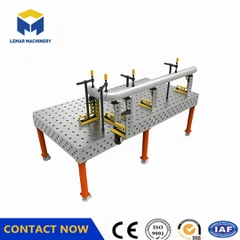
First, let's get on the same page about what a 3D welding table actually is. It's not your old-school flat metal table with a few holes drilled randomly. These are modular, grid-based platforms with a consistent hole pattern (usually 28mm or 16mm spacing) that let you use clamps, pins, and fixtures to hold workpieces at any angle or position. They're designed for flexibility-you can adjust setups quickly, reconfigure for different jobs, and get way more accuracy than a standard welding table. If you want to check out the basics, you can look at our Three-Dimensional Welding Platform page to see the core design. But here's the thing: that grid pattern can be a double-edged sword in a dirty environment. All those little holes and slots are perfect for holding clamps, but they're also magnets for weld spatter, metal shavings, and dust. So how do you keep it working when your shop isn't spotless?
Let's start with the table material, because that's the foundation of how it holds up in grime. A lot of cheaper 3D tables are made from thin steel or even cast iron that's not properly treated, but our best option for dirty shops is the 3D Cast Iron Flexible Welding Platform. Cast iron is super dense, so it doesn't warp easily from heat or impact-something that's big when you're grinding and welding all day. It also has a smooth, wear-resistant surface that's treated with a phosphate coating to fight rust and make cleaning easier. I've seen guys using these tables for years in shops that leave metal shavings on the floor, drag heavy parts around, and don't deep clean every week, and they still hold their tolerance. Compare that to a thin steel table, which can get scratched up, build up spatter in the holes, and start to warp after a few months in a dirty shop. Material matters more than most people think.
Next up is the clamping system, because if your clamps get gummed up with gunk, your setup won't be accurate, no matter how good the table is. The Clamping System Platform we offer is designed with the same grid spacing as the table, so it's easy to line up pins and clamps, but each component is built to be durable enough for heavy use. The quick-release pins, for example, have a coated surface that resists spatter sticking, and the clamps have wide handles that don't fill up with dust. In a dirty shop, you want clamps you can yank out of the holes even if there's a little spatter buildup-no fighting with stuck pins or parts that won't adjust. We also recommend that customers with really dirty environments pick up a set of stainless-steel pins for high-wear areas, since stainless doesn't rust and is less likely to get seized up from oil and metal dust.
Now, let's talk about what makes a 3D table good for dirty environments vs. one that'll fall apart. Modularity is a big one here, and that's what you'll find with our Modular Fixture Welding Tables. Instead of a fixed, one-piece table, these are made of individual grid sections that you can take apart if a section gets extra grime. If you have a week where you're doing a lot of grinding and there's metal shavings all over the table, you can unbolt one section at a time, dump the shavings, wipe it down, and put it back-no need to clean the whole table at once. That's a game-changer for busy shops that don't have time to deep clean for hours. A fixed table would make you either struggle to get into all the nooks or shut down work for cleaning, but modular tables work with your schedule, not against it.
Wait, but what if you need to move the table around a dirty space? A lot of guys think 3D tables are big and stationary, but no-we have Portable Welding Tables that are perfect if you work in a shop where you don't have a dedicated welding bay, or if you take work to different job sites. These are lightweight but still strong enough for heavy parts, and they have the same grid pattern and hole spacing as our full-size tables. I had a customer a few months back who does farm repair work-he's out in fields, in old barns, dealing with mud, rust, and all sorts of outdoor grime. He uses a portable 3D table and says he just wipes it down with a rag once a day, brushes out the holes when he's done for the week, and it works just as well as the big table back at his shop. The key here is that the portable models are made with the same durable materials, so they don't hold onto dirt the way a cheap portable table would.
Now, let's get real about maintenance-because even the best table won't work forever if you don't take care of it, especially in a dirty environment. I see guys make two big mistakes here: either they ignore cleaning altogether, or they over-clean with harsh chemicals that damage the table. The truth is, you don't need to deep clean every day. A quick wipe down with a dry rag after each job, and a brush to knock out any spatter or shavings from the holes, is enough. Once a week, a wipe with a mild degreaser is all you need-no abrasive stuff that scratches the surface. If you do get spatter stuck in the holes, a small pick (we sell these as an add-on) is way better than using a metal tool that could scratch the table or break the clamp pins. I also tell customers to avoid leaving oily rags on the table for long periods-oil can seep into the holes and cause rust, especially if the table is cold. That's an easy fix, and it keeps the table working even when there's oil drips around.
Let me address a common concern I hear: "Won't all the grime throw off the accuracy of the table?" Yeah, if you let it build up. But with the right table and basic maintenance, that's not an issue. The grid holes are precision-drilled to within a few tenths of a millimeter, so if there's a small bit of spatter in a hole, you just brush it out and the pin fits right in. We've tested our tables with weeks of simulated dirt-metal shavings, welding fumes, oil-and found that after proper cleaning, the accuracy stays consistent. I had a customer who works on heavy equipment, doing repairs on bulldozers and farm tractors-those environments are as dirty as it gets, with hydraulic fluid, dirt, and big metal parts that drag on the table. His 3D table is two years old, and he says it still holds parts within 0.5mm of accuracy, which is more than enough for his work.
Another thing to think about: if your shop is extra dirty (think: foundries, heavy fabrication with a lot of grinding), you can add a few extra layers of protection. Some customers put a thin, removable steel sheet over the table when they're doing extra-heavy grinding, so the shavings don't get into the grid holes. Once the grinding is done, they remove the sheet and go back to setting up welds. It's a simple trick that cuts down on cleaning time, and it doesn't affect the table's performance at all. The table's surface is still there to use for clamping and welding, you just have a barrier for the messy parts of the job.
Now, let's compare that to what happens if you use a regular welding table in a dirty environment vs. a 3D table. A regular flat table might be easier to wipe down on the surface, but when you have to set up parts, you have to measure and mark every angle, which takes way longer. In a dirty environment, where you're rushed to get jobs done, that extra time adds up. A 3D table lets you set up parts faster, so you're not hanging around your table getting more dirty, but you do have to keep the holes clean. It's a trade-off, but for most shops, the time saved is worth the small amount of cleaning.
I also want to mention that not all 3D tables are made the same. Some cheap ones you'll see online are made from thin steel with a rough surface, so spatter sticks like glue and builds up in the holes. Those will struggle in a dirty environment, because the surface is too soft, so spatter sinks in, and the holes can get distorted after a few months. The tables we offer have a precision-machined surface, so spatter sits on top, not inside the holes, and the hole walls are hard enough that they don't get deformed when you're pulling pins out. That's the difference between a table that works for years and one that's a waste of money.
So, to circle back to the original question: Can a 3D welding table top be used in a dirty environment? Yes, absolutely-if you pick a table designed for durability, follow a simple cleaning routine, and use the right clamps and accessories. It's not just possible; in my experience, it's better than old-school tables for busy, dirty shops, because it cuts down on setup time and holds up to the wear and tear.


If you're looking for a table that works in your shop, whether it's a dedicated fabrication space, a mobile repair setup, or somewhere that gets messy daily, we've got options. Our modular tables, portable models, cast iron platforms, and clamping systems are all built with dirty environments in mind, so you don't have to choose between performance and durability. If you want to chat about what would work best for your specific shop, reach out to our team to go over your needs and get a recommendation that fits.
Send Inquiry