

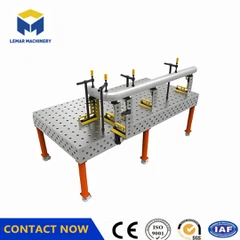


How to Adjust the Precision of a 3D Welding Worktable?
Feb 27, 2026
Leave a message
I. Preliminary Preparation: Cleaning and Inspection
Before any precision adjustment, ensure the worktable is clean and undamaged:
1. Thoroughly remove welding slag and oil: Wipe the worktable surface with a dedicated cleaner and a lint-free cloth, paying particular attention to cleaning the T-slots and positioning holes to prevent impurities from affecting measurement results.
2. Inspect surface damage: Observe for scratches, dents, or localized deformation, paying special attention to wear in areas subject to long-term off-center loading.
3. Confirm fixture integrity: Check that positioning pins, pressure plates, quick clamps, and other accessories are complete and move freely to avoid clamping errors caused by accessory issues.
Cleanliness is not only a hygiene requirement but also a prerequisite for precision adjustment.
II. Coarse Adjustment: Basic Level Correction (Establishing a Stable Benchmark)
The goal is to eliminate torsional stress caused by improper installation and ensure even force distribution at the support points.
1. Select high-precision measuring tools: Use a 00-grade coincidence level or electronic level. Self-calibration must be completed before measurement.
2. Leveling using the "three-point surface" method: First, adjust the three main support points to center the bubble in one direction (e.g., the long side); then adjust the fourth point to level in the vertical direction (e.g., the short side); repeat cross-measurements and fine-tuning until the readings in all directions are consistent.
3. Tighten anchor bolts: Evenly tighten all support bolts to prevent loosening and secondary deformation.
4. Environmental control: Avoid direct sunlight, wind, or vibration interference. Ensure the temperature is balanced with the workshop environment to prevent thermal expansion and contraction from affecting the results.
This stage does not pursue ultimate precision but rather establishes a macroscopically stable foundation for fine-tuning.
III. Fine-tuning: Repairing the flatness of the working surface (achieving microscopic precision) For local unevenness or deformation after welding repair, high-precision machining is required.
Method 1: Manual Scraping (Suitable for high-precision requirements)
Contact Point Inspection: Apply red lead to a standard flat surface and rub it against the workpiece surface, marking the highest contact points.
Successive Scraping: Each scraping step is controlled at 0.003–0.005 mm. Repeatedly check until the contact point density is ≥16 points/200mm × 200mm.
Advantages: Achieves flatness ≤0.03mm/m, a traditional "gold standard" method.
Method 2: Mechanical Milling (Suitable for large-area rapid repair)
Fix the platform onto a gantry milling machine, using the back rib plate as a reference for alignment.
Use a disc milling cutter to perform a single-pass precision milling of the entire workpiece surface.
Advantages: High efficiency, suitable for overall repair of large platforms.
Scraping is suitable for small-area, high-precision repairs, while milling is suitable for large-area, rapid restorations.
IV. Accuracy Calibration and Verification
After adjustment, the effect must be verified using professional instruments:
1. Laser Interferometer Scanning: Check the overall flatness to ensure it meets factory standards (usually ≤0.15mm/1000mm);
2. Coordinate Measuring Machine Verification: Check the positional tolerance of key positioning holes, requiring within ±0.05mm;
3. Regular Re-testing Mechanism: It is recommended to perform a comprehensive calibration every 6 months to promptly identify minor deviations.
Calibration is not a one-time task, but a core part of continuous maintenance.
V. Daily Maintenance Recommendations
1. Rotate Usage Areas: Avoid long-term unbalanced loading and implement a "regional rotation system" to distribute the load;
2. Spray Anti-spatter Liquid: Reduce weld slag adhesion and protect the table surface mesh holes and T-slots;
3. Prohibit Impacting or Arc Ignition: Prevent mechanical damage and electrical corrosion;
4. Rust Prevention Treatment When Idle: Apply rust-preventive oil and cover with dustproof cloth.

Send Inquiry