

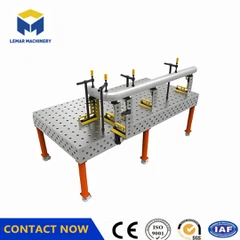
How to determine if a 3D welding worktable needs adjustment?
Mar 02, 2026
Leave a message
I. Based on Welding Quality and Repeatability Variations
Process performance directly reflects the precision status:
1. Inconsistent workpiece clamping position: Slight misalignment occurs after multiple installations using the same fixture, requiring manual correction to align the weld.
2. Welding misalignment or gap fluctuation: After ruling out robot programming issues, weld misalignment and uneven overlap persist.
3. Frequent product dimensional deviations: Key dimensions of parts exceed tolerances in multiple consecutive batches, with an increasing trend.
If the above problems persist after replacing the fixture or cleaning the T-slots, it is highly likely due to platform datum inaccuracy.
II. Inspect the physical condition of the worktable
Visible damage is often a precursor to precision degradation:
1. Severe localized wear: Increased burrs on T-slot edges in certain areas, enlarged orifice diameters, or large-area peeling of the anti-spatter coating.
2. Flatness Abnormalities: Gaps are found during ruler-fitting inspection, or there is a significant height difference (exceeding 0.05mm/m) between modules.
3. Loose Connection Structures: Loose bolts between modules, worn or even misaligned locating pins, affecting overall rigidity and consistency.
Pay special attention to areas with long-term off-center loads. These problems are initially hidden but accumulate over time, eventually leading to systemic inaccuracies.
III. Reliance on Professional Inspection Data
The most reliable method of judgment is periodic instrument inspection:
1. Laser Flatness Scan: Use a laser interferometer to check the overall flatness every 6 months. If the deviation exceeds 0.15mm/1000mm, immediate adjustment is required.
2. Coordinate Measuring Verification: Check the positional tolerance of key locating holes. A deviation exceeding ±0.05mm is considered inaccurate.
3. Levelness Comparison: Use a level to measure the tilt in all directions. If it exceeds 0.03mm/m, readjustment is required.
We recommend integrating a 3D shape inspection system (such as the LJ-X8000 series) to achieve automated monitoring and improve judgment efficiency and accuracy.
IV. Reference Usage Frequency and Operating Conditions Under high load or harsh environments, the inspection cycle should be shortened:
1. High-frequency heavy-load use (more than 8 hours per day): It is recommended to inspect every 3 months, and initiate adjustments as soon as a trend deviation is detected.
2. After undergoing off-center load repair or impact: Recalibration is necessary to prevent incomplete release of internal stress.
3. Large temperature differences or high humidity in the environment: Cast iron materials are susceptible to thermal expansion and contraction and corrosion, requiring enhanced monitoring.
In high-precision welding scenarios, AI-assisted analysis of historical data can be introduced to predict the optimal adjustment time.

Send Inquiry