

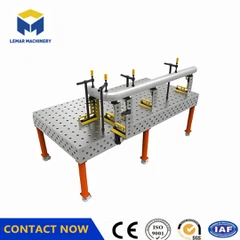










How to Maintain the Precision of a 3D Welding Workbench?
Feb 25, 2026
Leave a message
I. Standardized Operation to Avoid Human-Induced Damage
Improper operation is the primary cause of decreased precision. Standardized operating procedures must be established:
1. Do not ignite an arc on the workbench or directly ground it: Welding current passing through the platform body may cause localized high temperatures, resulting in thermal deformation or changes in microstructure.
2. Do not strike the work surface with hard objects: Hammering or impacts can cause deformation of T-slot edges and enlargement of hole diameters, affecting positioning accuracy.
3. Distribute the load evenly to prevent uneven loading: Avoid concentrating heavy workpieces in one area for extended periods. It is recommended to implement a "zone rotation system" to distribute the load.
4. Spray anti-spatter liquid before use: Effectively reduces weld slag adhesion and minimizes scratch damage to the workbench during cleaning.
Remove workpieces promptly after each operation to prevent accumulated elastic deformation due to heavy pressure.
II. Regular Cleaning and Maintenance of Key Components
Cleanliness is not only a hygiene requirement but also the foundation for ensuring accuracy:
1. Daily cleaning of surface welding slag and dust: Use a pneumatic slag remover or soft brush to remove residue and prevent impurities from embedding in the T-slots.
2. Weekly deep cleaning of T-slots and positioning holes: Use a dedicated cleaning knife or power tool to clean each slot individually, ensuring no blockages or rust.
3. Check fixture condition: Positioning pins, pressure plates, quick clamps, and other accessories should be free from wear and deformation; moving parts require regular lubrication.
4. Sensor contact surface cleaning: Wipe the photoelectric probe and measurement reference points with anhydrous alcohol to prevent signal drift.
After cleaning, be sure to dry thoroughly and apply a thin layer of anti-rust oil, especially in humid environments.
III. Periodic Accuracy Testing and Calibration
Small deviations cannot be detected visually alone and must be addressed using professional methods:
1. Perform a basic accuracy check every 3 months: Use a level to check the platform's levelness; the deviation should be controlled within 0.03 mm/m.
2. Perform a comprehensive calibration every 6 months: Use a laser interferometer or coordinate measuring machine to scan the overall flatness, ensuring ≤0.15mm/1000mm.
3. Verify the position of critical positioning holes: Tolerances should be controlled within ±0.05mm; adjustments or repairs are required if tolerances exceed this range.
4. Record historical data: Establish a trend chart of accuracy changes to facilitate early warning of potential problems.
For high-precision scenarios, a 3D shape detection system can be introduced for online monitoring.
IV. Environmental Control and Long-Term Storage Management
The external environment directly affects the platform's stability:
1. Install in a dry, temperature-controlled workshop: Avoid humidity, high temperatures, or drastic temperature differences to prevent moisture absorption and expansion or thermal deformation of the cast iron material.
2. Keep away from vibration sources: such as stamping machines, large fans, etc., to prevent continuous vibration from affecting the measurement benchmark.
3. Take protective measures when not in use for extended periods: Cover with a dust cover, apply rust-preventive oil to the table surface, and fill the T-slots with rust-preventive grease and seal them.
4. Avoid stacking during transportation and storage: The platform should be placed separately with a solid base to prevent deformation caused by suspension or compression.
It is recommended to maintain a room temperature of 20±5℃ and a relative humidity of ≤65% to maintain optimal performance.

Send Inquiry