

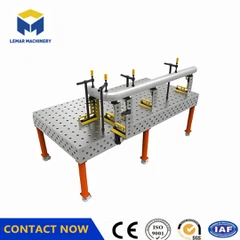
How to Determine if a 3D Welding Station Has Been Impacted
Apr 15, 2026
Leave a message
1. Appearance and Structural Damage
Dents, scratches, chipping, or cracks appear on the working surface, especially damage to the edges of the positioning holes;
Deformation, bending, or weld cracking occurs on the support legs or frame;
Peeling or localized discoloration of the surface paint may be caused by a high-temperature welding torch or impact from a heavy object.
2. Malfunctioning Positioning Holes
Multiple PC pins may jam, deviate, or fail to be fully inserted;
Previously smooth hole positions may suddenly become partially blocked or loose;
When using a standard gauge for inspection, the hole spacing is found to deviate significantly from the standard 100±0.05mm.
3. Sudden Deterioration in Flatness
The most recent measurement data shows a sudden deterioration in flatness (e.g., from 0.03 mm/m² to over 0.1 mm/m²);
Laser or electronic levels detect localized raised or recessed areas, distributed in a point-like or strip-like pattern;
In "grid" path measurements, data at certain measuring points show drastic jumps, inconsistent with the overall trend.
4. Abnormal Performance
After multiple clamping operations with the same fixture, the consistency of workpiece position deteriorates;
Misalignment, gaps, or loose connections occur during module assembly;
Frequent dimensional deviations in welded finished products, after ruling out human and process factors.
✅ Recommendation: If the platform has experienced handling, hoisting, or collisions with workshop equipment, even without obvious external damage, a comprehensive accuracy inspection should be performed immediately to prevent hidden damage from affecting long-term stability.

Send Inquiry