

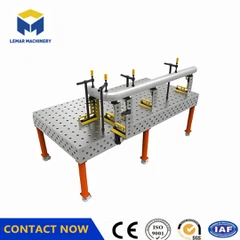





How to determine if a 3D welding table needs adjustment?
Apr 13, 2026
Leave a message
1. Measurement Data Exceeds Standards
When using an electronic level or laser flatness gauge, the measured flatness exceeds 0.08mm/m² (conventional platform) or 0.02mm/m² (high-precision platform);
The tolerance of the distance between adjacent positioning holes exceeds ±0.05mm, and the diagonal length difference is >0.1mm;
Significant deflection changes during load testing, and the original shape cannot be restored after unloading.
2. Abnormal Workpiece Clamping and Welding
Difficulty in workpiece positioning, PC pin insertion jamming or misalignment;
Dimensional deviations or misalignments occur when clamping the same workpiece multiple times;
Increased deformation and decreased consistency of components after welding;
Joint misalignment and loose connections occur at module splicing points.
3. External Factors
The platform was not releveled after being moved, hoisted, or impacted;
Workshop floor settlement, change of vibration source (e.g., addition of stamping equipment);
Severe fluctuations in ambient temperature (e.g., diurnal temperature difference >10℃), leading to thermal expansion and contraction.
✅ Recommendation: A comprehensive test and adjustment should be performed after the installation of a new platform, after major repairs, or during routine quarterly maintenance to ensure the stability of the baseline.

Send Inquiry