

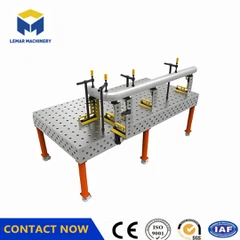





How to determine if a 3D welding workbench needs maintenance?
Feb 20, 2026
Leave a message
I. Based on usage frequency and time cycle
Even without obvious abnormalities, preventative maintenance should be performed at fixed intervals:
Every 3 months: Perform basic cleaning and inspection, applicable to normal production environments.
Every 6 months: Perform accuracy calibration, including flatness testing and sensor calibration.
High-frequency use (more than 8 hours per day) or heavy-load conditions: It is recommended to shorten maintenance to once every 1-2 months.
If there are intensive welding tasks in the near future, heavy workpieces, or new fixtures are being replaced, maintenance should be scheduled in advance.
II. Observe changes in physical condition
Visible abnormalities on the workbench surface and structure are direct signals of maintenance needs:
1. Severe surface contamination: Weld slag accumulation, oil stains, T-slot blockage, affecting the normal insertion of locating pins.
2. Localized wear or deformation: Enlarged hole diameter in certain areas, increased edge burrs, or gaps found by ruler inspection.
3. Loose module connections: Misalignment between adjacent modules, loose connecting bolts, or worn locating pins. 4. Anti-spatter coating peeling: Large areas of exposed metal are prone to corrosion and require recoating with a protective layer.
Pay special attention to the cumulative damage in areas with long-term off-center loading; these problems are not easily detected initially but have far-reaching consequences.
III. Monitoring Welding Accuracy and Repeatability
Deteriorating process performance is often an external reflection of internal problems:
1. Workpiece clamping position deviation: Inconsistent results from multiple clamping attempts with the same fixture.
2. Welding misalignment or uneven gaps: After ruling out robot program issues, platform positioning inaccuracy is suspected.
3. Increased repeatability error: Dimensional fluctuations exceeding the allowable range for several consecutive batches of products.
In this case, priority should be given to checking the platform flatness and the positional tolerance of key positioning holes (required to be within ±0.05mm).
IV. Reliance on System and Operational Feedback
Automation system alarms or operator perception can also serve as a basis for judgment:
1. Frequent robot TCP point offset: Manual fine-tuning is required to align the weld, which may be related to platform datum instability.
2. Fixture installation difficulties: The previously smooth insertion of the PC pins is obstructed, indicating hole deformation or foreign object blockage.
3. Control system anomalies: Such as automatic leveling system alarms, unstable sensor signals, etc.
4. Developing trend analysis based on daily inspection records helps to predict maintenance needs in advance.

Send Inquiry