

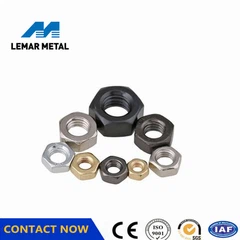


Hexagon Lock Nut
Anti-loosening type: locking
Material: Q235 carbon steel/Stainless steel
Exterior Finish:Plain
Products Description And Parameter
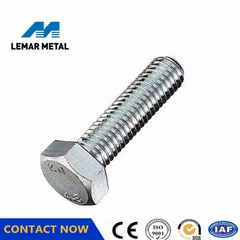
Hexagon lock nut is a common fastener, and its name comes from its hexagonal appearance. It is mainly used to provide additional friction between the bolt and the nut, so as to achieve the purpose of preventing loosening. The working principle of the hexagonal lock nut is to produce an interference fit relationship between the threads when it is matched with the bolt through the deformation of the thread bottom hole or the deformation of the thread tooth shape, thereby increasing the friction between the threads and achieving the effect of preventing loosening.
Parameter

|
D(Nominal diameter) |
P(Pitch) |
Thickness m |
Opposite s |
||
|
max |
min |
max |
min |
||
|
M1.2 |
0.25 |
1.2 |
1.1 |
2.5 |
2.4 |
|
M1.4 |
0.3 |
1.2 |
1.1 |
2.6 |
2.5 |
|
M1.6 |
0.35 |
1.3 |
1.15 |
3.2 |
3.02 |
|
M2 |
0.4 |
1.6 |
1.35 |
4 |
3.82 |
|
M2.5 |
0.45 |
2 |
1.75 |
5 |
4.82 |
|
M2.6 |
0.45 |
2 |
1.75 |
5 |
4.82 |
|
M3 |
0.5 |
2.4 |
2.55 |
5.5 |
5.32 |
|
M3.5 |
0.6 |
2.8 |
2.65 |
6 |
5.82 |
|
M4 |
0.7 |
3.2 |
3.7 |
7 |
6.78 |
|
M5 |
0.8 |
4 |
3.7 |
8 |
7.78 |
|
M6 |
1 |
5 |
4.7 |
10 |
9.78 |
|
M8 |
1.25 |
6.5 |
6.14 |
13 |
12.73 |
|
M10 |
1.5 |
8 |
7.64 |
17 |
16.73 |
|
M12 |
1.75 |
10 |
9.64 |
19 |
18.67 |
|
M14 |
2 |
11 |
10.3 |
22 |
21.67 |
|
M16 |
2 |
13 |
12.3 |
24 |
23.67 |
|
M18 |
2.5 |
15 |
14.3 |
27 |
26.16 |
|
M20 |
2.5 |
16 |
14.9 |
30 |
29.16 |
|
M22 |
2.5 |
18 |
16.9 |
32 |
31 |
|
M24 |
3 |
19 |
17.7 |
36 |
35 |
|
M27 |
3 |
22 |
20.7 |
41 |
40 |
|
M30 |
3.5 |
24 |
22.7 |
46 |
45 |
|
M33 |
3.5 |
26 |
24.7 |
50 |
49 |
product details and features
Hexagon lock nut types

All-metal locking nuts achieve the purpose of preventing loosening by increasing the friction between threads through the deformation of the thread bottom hole or the deformation of the thread tooth shape. This type of nut has a relatively high reliability in preventing loosening under vibration conditions; locking nuts made of different metal materials can be used under conditions of different temperatures. However, due to the deformation resistance of the metal material itself, the deformation of the all-metal nut is difficult to control, which will lead to a large dispersion of the anti-loosening torque and the assembly is prone to jamming.

Non-metallic insert locking nuts
Non-metallic insert nuts are nuts with non-metallic materials such as nylon blocks embedded in their threaded holes. When this type of nut is screwed together, the thread of the bolt will naturally squeeze into a spiral on the nylon ring, allowing it to form a tight fit with the bolt thread, and generate friction resistance under the elastic force of nylon to achieve the purpose of preventing loosening. The assembly torque of non-metallic insert locking nuts is relatively stable, and they are very reliable in preventing loosening, and can be used in situations of impact and vibration. However, it is not suitable for use in high temperature conditions, nor in inorganic acid or strong alkali environments.

Slotted and closed locking nuts
When the bolt is screwed into the nut during use, the end of the nut will be automatically stretched open.
Under the action of the deformation force of the nut, the thread will fit tightly and generate friction resistance to prevent loosening. The torque of the slotted and closed locking nut is stable, the anti-loosening effect is good, and it can be reused.
By changing the material of the nut, it can be applied to working conditions at different temperatures
Products Display
Hot Tags: hexagon lock nut, China hexagon lock nut manufacturers, suppliers, factory, transmission fasteners, Antiluce Drop Lock, Replacement Blade Bolts, Cabinet Latch Lock, DIN6923 Flange Nut, Slide Bolt Latch
You Might Also Like


Send Inquiry