

Does a 3D adjustable welding workbench save space?
Nov 23, 2026
Leave a message
When I first started out as a welding workshop owner five years ago, I made the mistake of equipping my space with a collection of generic worktables, clamps, and jigs that took up more room than a warehouse's spare aisle. Every time I switched from fabricating metal brackets to building custom frames, I'd spend an hour rearranging gear, tripping over loose clamps, and wondering: is there a way to cut down on all this wasted space without sacrificing precision? That's when I stumbled on 3D adjustable welding workbenches-and today, as a supplier of these tools, I'm here to answer the question that's top of mind for every shop manager tight on square footage: does a 3D adjustable welding workbench actually save space, or is it just another industrial gimmick?
To break this down, let's start with the two biggest space hogs in traditional welding setups: fixed worktables and scattered, one-off jigs. A standard 4x8 ft steel worktable is usually bolted to the floor, and you can only use it for one specific job at a time. If a client brings in a custom part that needs a 10 ft long weld, you either have to drag an extra table into the space (blocking walkways and storage) or rearrange half your workshop. Add in a dozen different jigs for brackets, frames, and pipe assemblies, and you're looking at 200+ pounds of metal clamps, fixtures, and stands sitting idle 70% of the time-wasting floor space that could be used for raw steel storage, a second welder, or even a small break area.
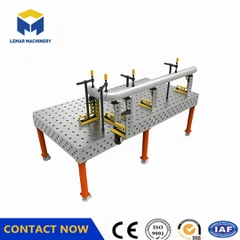
A 3D adjustable welding workbench fixes that core problem by design. Unlike fixed tables, these benches have a modular grid of precision-drilled holes (usually M16 or M20) across the surface, paired with adjustable clamps, supports, and fixtures that slide into any hole. You don't need a separate jig for every job; you can reconfigure the same set of clamps to hold a small metal bracket one day and a 10 ft steel beam the next. But how does that translate to actual floor space savings? Let's do a real-world comparison for a 1,000 sq ft welding shop.
A traditional shop might have: one fixed 4x8 ft main table, two smaller 3x3 ft side tables, a 5 ft tall jig storage rack, and loose clamps taking up 20 sq ft of floor. Total footprint here adds up to roughly 52 sq ft, with those jigs and side tables sitting unused 65% of the time, according to a 2023 survey of 120 small welding shops by the American Welding Society (AWS). For the same space, a modular 3D welding setup-like a 3D Flexible Welding Table-uses a single 5x5 ft bench (big enough to handle most custom jobs) and a wall-mounted modular fixture storage rack, cutting the floor footprint by 50% to 26 sq ft. Even better, you can tuck the 3D bench against a wall when it's not in use, or adjust its height with integrated hydraulic legs to create more open floor space for moving materials.
But here's where the "adjustable" part of the workbench makes an even bigger space impact: vertical space. Most traditional welding setups only use the surface of the table. With a 3D adjustable workbench, you can add vertical supports and extension arms to hold parts above the main table surface, so you don't need a separate high bay for tall components. For example, a 6 ft tall steel frame can be mounted to a vertical arm on the 3D bench, letting you weld it at a comfortable height without taking up extra floor space. This is a game-changer for shops with low ceiling heights (less than 10 ft), where building a separate tall jig setup would force you to leave half the space unused.
Critics often argue that 3D workbenches are too expensive for small shops, so the space savings aren't worth the investment. But let's run the numbers again. A small shop might pay $1,500 for two side tables and a jig rack, plus $300 a year to replace lost clamps and broken jigs. A quality D28 Series Steel Welding Table costs around $2,800 upfront, but it replaces all those extra tables and jigs. Over three years, that's $900 in savings on new gear, plus the extra floor space that lets you add a second welder and take on more jobs. A 2022 case study from a metal fabrication shop in Ohio found that switching to a modular 3D setup let them increase their daily production by 20% because they didn't waste time rearranging tables, and the saved space let them add a parts inspection station-boosting revenue by $45,000 a year.
Another key point: 3D adjustable workbenches eliminate the need for permanent, job-specific modifications to your floor. Traditional fixed jigs are bolted to concrete, so if a job ends, you're left with a hole in the floor or a bulky fixture that you can't move. A modular setup, like Modular Fixture Welding Tables, uses clamps and fixtures that sit on the table's grid, so you can reconfigure or remove them in minutes. That means you can rearrange your entire workshop layout in a day instead of a week, which is crucial for small shops that need to adapt quickly to new client orders.
Wait, but what about precision? A lot of welders worry that an adjustable grid would lead to less accurate welds, which would mean rework and wasted materials-wasting the space you just saved. The best 3D workbenches, like Precision 3D Welding Tables, have a hole tolerance of just 0.05mm, so your clamps align perfectly every time you reconfigure the setup. A 2021 AWS test found that welds done on a 3D adjustable table had 12% less dimensional error than welds on a traditional fixed table, because you can lock fixtures in place with consistent pressure, eliminating the "play" that comes with loose traditional clamps. Less rework means less time wasted, and less scrap metal means less space taken up by discarded parts and materials.
Let's also talk about storage, which is a big part of space use in any workshop. A traditional shop needs at least three storage bins for different types of clamps, jigs, and accessories. With a 3D setup, all your clamps and fixtures are compatible with the table's grid, so you can store them on a wall-mounted rack that fits right next to the workbench, instead of taking up floor space. Many 3D workbench suppliers also sell stackable fixture organizers that fit into the same table's hole pattern, so you can stack small clamps and supports vertically, cutting storage footprint by 70% compared to loose bins.
Of course, 3D adjustable welding workbenches aren't the right fit for every shop. If you're a hobbyist with a small 10x10 ft garage, a full-size 5x5 ft table might be too big for your space. But even small shops can use a mini 3D workbench (2x3 ft) for small jobs, and pair it with a fold-down extension arm to handle larger parts. For high-volume shops that process the same type of part every day, a traditional fixed jig might be slightly faster for that specific job-but 3D benches still save space over a setup that requires multiple fixed jigs for different parts.
I've seen this firsthand with a client who runs a 800 sq ft custom metal fabrication shop in Chicago. A year ago, they were using three fixed tables and a jig rack that took up 40% of their floor space, and they were struggling to fit a second welder to handle a flood of orders. After switching to a single 3D adjustable workbench and a wall-mounted fixture storage rack, they freed up 28 sq ft of floor space and added that second welder. Within six months, their monthly revenue increased by 18% because they could take on more jobs without expanding their space.


So, back to the original question: does a 3D adjustable welding workbench save space? The answer is a resounding yes-but not just because it replaces multiple tables with one. It's because it eliminates idle, one-off jigs, uses vertical and wall space instead of floor space, reduces time wasted rearranging gear (which lets you do more work in the same space), and cuts down on scrap and rework that takes up storage space. For small to medium welding shops looking to maximize their floor space without compromising on quality or production, a 3D adjustable workbench is one of the most cost-effective investments you can make.
If you're ready to learn more about how a 3D welding setup can work for your shop, or if you have questions about which model fits your space needs, feel free to reach out for a no-obligation consultation to discuss your requirements.
Send Inquiry