


How to ensure the flatness of a flat washer?
Jul 14, 2025
Leave a message
As a seasoned flat washer supplier, I understand the critical importance of flatness in flat washers. Flatness is not just a matter of aesthetics; it directly impacts the functionality, performance, and safety of the applications where these washers are used. In this blog post, I'll share some insights and strategies on how to ensure the flatness of flat washers.
Understanding the Significance of Flatness
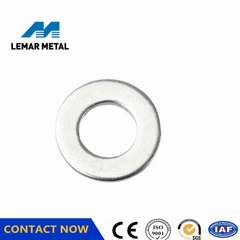
Flat washers are used in a wide range of applications, from automotive and aerospace industries to construction and electronics. Their primary function is to distribute the load of a threaded fastener, such as a bolt or a screw, over a larger area. This helps prevent damage to the surface being fastened and ensures a more secure connection. However, if a flat washer is not flat, it can lead to uneven load distribution, which may result in loosening of the fastener, premature wear, and even failure of the entire assembly.
Raw Material Selection
The journey to achieving flat washers with excellent flatness begins with the selection of high - quality raw materials. The material should have consistent properties throughout. For example, steel is a commonly used material for flat washers. When sourcing steel, we look for suppliers who can provide material with a uniform grain structure and minimal internal stresses.
Aluminum is another popular choice, especially for applications where weight is a concern. We ensure that the aluminum used has the right hardness and ductility to maintain its shape during the manufacturing process. For applications requiring corrosion resistance, Galvanized Flat Washers are a great option. The galvanization process not only protects the washer from rust but also helps in maintaining the flatness of the washer as the coating is applied evenly.
Precision Manufacturing Processes
Stamping
Stamping is one of the most common methods for manufacturing flat washers. To ensure flatness during stamping, we use high - precision stamping dies. These dies are carefully designed and machined to have a flat surface. The stamping press must also be properly calibrated to apply a uniform force across the entire surface of the blank material.
We monitor the stamping process closely, checking the pressure, speed, and alignment of the press. Any deviation from the set parameters can lead to uneven deformation of the washer, resulting in poor flatness. For example, if the pressure is too high on one side of the blank, the washer may end up being concave or convex.
Machining
In some cases, machining is used to produce flat washers, especially for high - precision or custom - made washers. During machining, we use advanced CNC machines. These machines can precisely control the cutting tools to remove material evenly from the surface of the washer.
For example, when machining Brass Flat Washer, we program the CNC machine to make multiple passes with a fine - tipped cutting tool. This helps in achieving a smooth and flat surface. We also use coolant during the machining process to prevent overheating, which can cause the material to warp and affect the flatness.
Heat Treatment
Heat treatment can be used to relieve internal stresses in the flat washers. After stamping or machining, the washers may have residual stresses that can cause them to deform over time. By subjecting the washers to a controlled heat treatment process, we can reduce these stresses.
For steel washers, annealing is a common heat - treatment process. The washers are heated to a specific temperature and then slowly cooled. This allows the internal stresses to be released gradually, resulting in a more stable and flat washer.
Quality Control Measures
In - process Inspection
During the manufacturing process, we conduct in - process inspections at multiple stages. After stamping, we use optical measurement systems to check the flatness of the washers. These systems can quickly and accurately detect any deviations from the desired flatness.


We also perform manual inspections, using feeler gauges to measure the gap between the washer and a flat surface. If the gap exceeds the specified tolerance, the washer is either re - worked or rejected.
Final Inspection
Before the flat washers are shipped to our customers, a final inspection is carried out. We use coordinate measuring machines (CMMs) to measure the flatness of a sample of washers from each batch. CMMs can provide highly accurate three - dimensional measurements, ensuring that the washers meet the required flatness standards.
For example, for DIN 9021 Flat Washers, which have specific flatness requirements according to the DIN standard, we ensure that each batch is thoroughly inspected against these standards.
Storage and Packaging
Proper storage and packaging are also crucial to maintaining the flatness of flat washers. After inspection, the washers are stored in a clean and dry environment. We use racks or containers that prevent the washers from being stacked in a way that could cause deformation.
When packaging the washers, we use materials that provide cushioning and protection. For example, we may use foam inserts or plastic bags with a layer of padding. This helps prevent the washers from being damaged during transportation, which could affect their flatness.
Continuous Improvement
We are committed to continuous improvement in our processes to ensure the highest level of flatness in our flat washers. We regularly review our manufacturing data, looking for trends in flatness issues. If we notice a particular batch of washers has a higher rate of flatness problems, we conduct a root - cause analysis.
We also invest in research and development to explore new materials and manufacturing techniques. For example, we are currently looking into the use of advanced coatings that can not only improve the corrosion resistance but also enhance the flatness of the washers.
Conclusion
Ensuring the flatness of flat washers is a multi - step process that involves careful raw material selection, precision manufacturing, effective quality control, and proper storage and packaging. At our company, we take pride in providing our customers with flat washers that meet the highest standards of flatness.
If you are in need of high - quality flat washers for your application, whether it's Galvanized Flat Washers, Brass Flat Washer, or DIN 9021 Flat Washers, we invite you to contact us for a purchase negotiation. We are confident that our expertise and commitment to quality will meet your requirements.
References
- ASME B18.21.1 - Standard for Plain Washers
- DIN 9021 - German standard for flat washers
- Manufacturing Engineering and Technology by S. Kalpakjian and S. R. Schmid
Send Inquiry