






How to test the strength of a hexagon nut?
May 23, 2025
Leave a message
As a hexagon nut supplier, ensuring the quality and strength of our products is of utmost importance. Hexagon nuts are widely used in various industries, from construction to automotive, and their strength directly impacts the safety and reliability of the assembled structures. In this blog post, I will share several methods on how to test the strength of a hexagon nut.
1. Tensile Testing
Tensile testing is one of the most common and reliable methods to evaluate the strength of a hexagon nut. This test measures the maximum amount of tensile force a nut can withstand before it fails.
Procedure
- First, select a representative sample of hexagon nuts from the production batch. The sample size should be determined according to relevant standards or industry practices.
- Prepare a tensile testing machine, which consists of a frame, a load cell, and grips. The grips are used to hold the nut firmly in place.
- Attach the nut to the testing machine. Make sure the nut is properly aligned to ensure accurate results.
- Apply a gradually increasing tensile force to the nut until it fails. The load cell records the force applied during the test.
- Measure the ultimate tensile strength (UTS) of the nut, which is the maximum force the nut can withstand divided by its cross - sectional area.
Significance
Tensile testing provides valuable information about the material properties of the hexagon nut. A high UTS indicates that the nut can withstand significant pulling forces without breaking, which is crucial in applications where the nut is subject to tension, such as in bolted connections under load.
2. Hardness Testing
Hardness is another important property that affects the strength of a hexagon nut. A harder nut is generally more resistant to deformation and wear.
Procedure
- There are several methods for hardness testing, such as the Brinell, Rockwell, and Vickers hardness tests.
- For the Brinell hardness test, a hardened steel ball is pressed into the surface of the nut under a specified load for a certain period of time. The diameter of the indentation left on the nut's surface is measured, and the Brinell hardness number (BHN) is calculated based on the load and the indentation diameter.
- The Rockwell hardness test uses a diamond cone or a hardened steel ball indenter. The indenter is pressed into the nut's surface, and the depth of the indentation is measured. The Rockwell hardness number is determined based on the difference in depth before and after the application of the load.
- The Vickers hardness test uses a square - based diamond pyramid indenter. Similar to the other tests, the indenter is pressed into the nut, and the size of the indentation is measured to calculate the Vickers hardness number (HV).
Significance
Hardness testing helps to ensure that the hexagon nut is made of the right material and has been properly heat - treated. A nut with the appropriate hardness will have better resistance to galling, which can occur when two metal surfaces rub against each other. It also indicates the nut's ability to maintain its shape and integrity under stress.


3. Torque - Tension Testing
Torque - tension testing is used to determine the relationship between the torque applied to a nut and the resulting tension in the bolt. This is important because the correct pre - load in a bolted connection is essential for its proper functioning.
Procedure
- First, assemble a bolt - nut combination with a washer if necessary.
- Use a torque wrench to apply a specific torque to the nut. The torque value should be selected based on the application requirements and the size of the bolt and nut.
- Measure the tension in the bolt using a tension measuring device, such as a load cell or a strain gauge.
- Repeat the test several times with different torque values to establish the torque - tension relationship.
Significance
Torque - tension testing helps to ensure that the hexagon nut is tightened to the correct level. Over - tightening can lead to bolt breakage or damage to the nut, while under - tightening can result in a loose connection that may fail under load. By understanding the torque - tension relationship, we can specify the appropriate torque values for our customers to ensure the safety and reliability of their applications.
4. Impact Testing
Impact testing is used to evaluate the nut's ability to withstand sudden shock loads. This is particularly important in applications where the nut may be subjected to dynamic forces, such as in machinery or vehicles.
Procedure
- There are two main types of impact tests: the Charpy impact test and the Izod impact test.
- For the Charpy impact test, a notched specimen of the nut material is placed in a Charpy impact testing machine. A pendulum is released from a certain height, and it strikes the specimen at the notch. The energy absorbed by the specimen during the impact is measured.
- The Izod impact test is similar, but the specimen is held in a different way. The specimen is clamped vertically, and the pendulum strikes it at the free end.
Significance
Impact testing provides information about the toughness of the hexagon nut. A nut with high toughness can absorb more energy during an impact without fracturing, which is crucial for applications where sudden shock loads are likely to occur.
Our Product Range
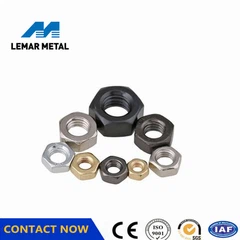
At our company, we offer a wide range of hexagon nuts, including Hexagon Lock Nut, Cutting PAL Nuts, and Iron Hexagon Nut. All our products are rigorously tested using the methods described above to ensure their high quality and strength.
Contact Us for Procurement
If you are in need of high - quality hexagon nuts for your projects, we would be delighted to discuss your requirements. Our team of experts can provide you with detailed product information and assist you in selecting the most suitable nuts for your applications. Please feel free to contact us for procurement and further discussions.
References
- ASTM International. "Standard Test Methods for Mechanical Testing of Steel Products." ASTM A370.
- ISO (International Organization for Standardization). "ISO 898-1:2013 - Mechanical properties of fasteners made of carbon steel and alloy steel - Part 1: Bolts, screws and studs with specified property classes - Coarse thread and fine pitch thread."
- Machinery's Handbook, 31st Edition. Industrial Press Inc.
Send Inquiry