

Is the D28 Welding Table compatible with robotic welding systems?
Oct 29, 2026
Leave a message
If you've ever walked through a modern automotive parts fabrication shop, a heavy equipment assembly line, or a precision metalworking facility, you've probably seen two things side-by-side: robotic welding arms moving with consistent, precision speed, and sturdy, modular work tables holding parts in place without shifting. As a supplier of D28 Welding Tables, one of the most common questions I get from potential clients and current customers alike is: Is the D28 Welding Table compatible with robotic welding systems? The short answer is a resounding yes-but the details of why that works, how it integrates, and what makes it better than generic work surfaces for automated welding are worth breaking down. After all, robotic welding isn't just about the arm that does the welding; it's about every component that supports the process, and the work table is far more critical here than many first-time automation adopters realize.
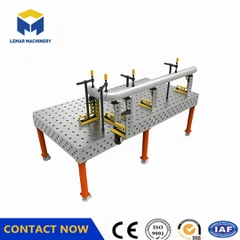
Let's start with the core of what makes robotic welding tick. Robotic welding systems rely on repeatability, accuracy, and the ability to hold a part in a fixed position over hundreds, thousands, or even millions of welds. Even a tiny shift of a part by a millimeter can throw off a weld joint, leading to defects, rework, or wasted material. That's where a work table comes in-and not just any work table. Generic metal workbenches, even heavy-duty ones, lack the precision and adjustability that robotic welding needs. That's where D28 series tables come into play. Unlike rigid, one-off welding stands, the D28 Welding Table uses a standard 28mm hole pattern across its surface, paired with matching clamps, locators, and fixturing components that lock parts in place with near-micron-level consistency. This isn't a random design choice; it's built to work in sync with robotic welding workflows from day one.
One of the first ways the D28 series integrates with robotic systems is through fixturing flexibility. Robotic welding is used for everything from small brackets to large frame assemblies, and no two parts are exactly the same (even in high-volume production). The D28 Welding Table's modular design means you can reconfigure fixtures in minutes, not hours, to switch between part runs. Let's compare that to a custom-built welding jig, which is often designed for one specific part, takes days or weeks to modify, and isn't compatible with changes in a production line. For robotic welding, that adaptability is a game-changer. If you add a new part to your line, you don't have to invest in a whole new work surface-you just adjust the existing D28 components. That's why so many automation engineers and production managers turn to 3D Flexible Welding Table when setting up robotic welding cells, because it balances the precision needed for automation with the flexibility to adapt to changing production needs.
Another key point is the physical compatibility of the D28 table with robotic arm programming and workspace layouts. Robotic welding arms have a defined work envelope-the area they can reach without colliding with other equipment, including work tables. The D28 series is manufactured with consistent, flat surface tolerance across every inch of its tabletop. No warping, no uneven edges, no high and low spots that would throw off a robot's path during programming. I've seen this firsthand: a client of mine was using a competitor's generic welding table for their new robotic line, and within a week, the robot was catching the edge of the table during a full extension. The D28 table's uniform thickness and flatness eliminate that risk, making programming straightforward and collision-free. Even when integrating with custom robotic fixtures, the standardized hole pattern of the D28 series means you can mount additional components directly to the table without custom machining, saving time and reducing the chance of alignment errors.
Let's talk about material stability too-something that's often overlooked when matching work tables to robotic welding. Robotic welding generates a lot of heat, even when working with thin materials, and that heat can cause a work table to warp or shift over time. The D28 Welding Table is made from high-grade, stress-relieved steel, heat-treated to resist deformation from repeated welding cycles and heat buildup. I've heard from clients who have used their D28 tables for 5+ years on 8-hour robotic shifts, with no measurable warping or shift in hole alignment. That stability is critical for robotic welding, because over time, a warped table would make the robot's pre-programmed weld paths inaccurate. With the D28 series, you don't have to recalibrate the table's position every few months-something that's almost a requirement with cheaper, non-heat-treated tables.
Of course, compatibility isn't just about physical design; it's about workflow integration. Robotic welding cells need to be part of a larger production line, with parts moving in and out of the work area quickly. The D28 series works seamlessly with automated part loaders and unloaders. Many of my clients use conveyors that line up with the edges of the D28 table, so parts can be transferred directly from the conveyor to the table's fixturing in seconds. The standard hole pattern also works with automation tooling-you can mount pneumatic clamps or quick-release fixtures that are controlled by the robotic cell's PLC, so the entire process is hands-off. That's a far cry from manual welding tables, where an operator has to adjust clamps by hand between parts. For robotic welding, the D28 table turns a semi-automated process into a fully automated one, without any of the compatibility headaches.
I know what some of you might be thinking: "What about smaller robotic setups, or hobbyist shops that use cobots (collaborative robots) for welding?" The D28 series isn't just for large industrial robotic arms. The 3D Welding Fixture Workbench variant of the D28 line is designed to fit cobot work envelopes, with smaller footprints and the same precise hole pattern. Cobots are growing in popularity for small-batch production, prototype work, and small shops, and they still need the same level of part stability as large industrial robots. I recently worked with a small fabrication shop that uses a 6-axis cobot for welding custom farm equipment parts, and they switched from a heavy steel workbench to a small D28 table. They told me their weld defect rate dropped by 12% within the first month, because the parts were held so consistently, and the cobot's programming was simplified-no more adjusting for table warpage or part shift.
Now, let's address a common misconception: some people think modular welding tables like the D28 are less durable than heavy-duty steel tables for robotic welding. That's not true, but it's important to choose the right table for your robotic setup. The D28 Series is specifically engineered for high-cycle welding environments, with load capacities that match most standard robotic welding applications. Whether you're welding 1lb brackets or 50lb frame assemblies, there's a D28 table that can handle the load, while maintaining its flatness and alignment. The key here is to match the table's load capacity to your robotic cell's needs, and that's why having a range of options matters. For example, the Standard 3D Welding Tables are a great fit for lighter robotic applications, while the heavy-duty D28 variants are designed for thicker materials and higher workloads.


Another benefit that's tied directly to robotic welding compatibility is data and calibration. Many modern robotic welding systems have built-in sensors that monitor part position and weld quality. The D28 table's standardized design means you can create a single fixture setup that works across multiple tables, or replicate a setup exactly on a new table if you expand your robotic line. That consistency makes it easy to calibrate the robot across multiple work cells, which is a huge time-saver for production managers. I've had a client with four separate robotic welding cells, each using a D28 table, and they were able to transfer their robot's calibration from one cell to another in less than an hour-something that would take a full day with custom jig setups.
Of course, no conversation about work table compatibility is complete without talking about long-term value. When you invest in a robotic welding system, you want equipment that will last, that won't require constant modifications, and that will work as you scale production. The D28 Welding Table isn't just compatible with robotic welding today-it's compatible with your needs tomorrow. If you decide to add more robotic arms to your line, or switch to a different type of robot, the standardized hole pattern and modular design mean you can adapt the D28 tables instead of replacing them. Compare that to custom jigs, which become obsolete as soon as your part design changes or your robotic setup is modified. That's why so many forward-thinking manufacturers refer to the 3D Welding Table D28 Series as a long-term investment, not just a one-time purchase.
I should also mention some real-world pain points that I've helped clients solve with D28 tables and robotic welding. A few months ago, a client in the agricultural equipment space came to me with a problem: their robotic welding cell was producing 8-10 defective welds per week on large frame assemblies, because the custom jig they were using shifted slightly every 2,000 welds. They tried adjusting the robot's path, replacing the jig, and even adding weight to the base-nothing worked. When they switched to the D28 Series Flexible Welding Tables and paired it with modular fixturing, the defect rate dropped to less than one per month. The reason? The D28 table's heat-treated steel didn't shift under the repeated welding heat, and the modular fixtures locked the parts in place with consistent pressure, every time. That's the kind of result that makes all the difference in a production environment where downtime and rework eat into profits.
Let's wrap this up by answering the original question clearly: Yes, the D28 Welding Table is extremely compatible with robotic welding systems, from small cobot setups to large industrial production lines. Its standardized design, precision flatness, stress-relieved construction, and modular fixturing all work together to create a seamless integration between robotic arms and the parts being welded. It eliminates common pain points like table warpage, part shift, custom jig obsolescence, and programming headaches that many manufacturers face when pairing welding robots with work surfaces.
If you're planning to set up a new robotic welding cell, or you're looking to upgrade your current setup to reduce defects and increase efficiency, the D28 Welding Table is a solution worth considering. It's not just a work surface-it's a core component that enables your robotic system to perform at its best, day in and day out. To discuss how the D28 series can work with your specific robotic welding needs, reach out to our team for a customized consultation and quote.
Send Inquiry