
What are the limitations of a Special Welding Platform?
Oct 05, 2026
Leave a message
In the realm of industrial manufacturing, special welding platforms stand as crucial tools, offering remarkable precision and efficiency in welding operations. As a dedicated supplier of such platforms, I've witnessed firsthand their transformative impact on various industries. However, like any technology, special welding platforms are not without their limitations. This exploration delves into these constraints, aiming to provide a comprehensive understanding for those considering integration into their operations.
1. Initial Investment and Cost Constraints
One of the most significant limitations of special welding platforms is the hefty initial investment they demand. These platforms are engineered with advanced technologies and high - quality materials, which drive up their costs. For small and medium - sized enterprises (SMEs), the price tag can be a formidable barrier to entry. The cost encompasses not only the purchase of the platform itself but also installation, training, and software licensing fees if the platform is automated. Even for larger companies, the financial outlay needs careful consideration, as it impacts the budget that could otherwise be allocated to other areas of production or R & D.
Moreover, the long - term maintenance costs of special welding platforms can be substantial. Regular calibration, replacement of worn - out parts, and software updates are necessary to ensure optimal performance. For instance, a High - Precision 3D Positioning Platform requires frequent calibration to maintain its accuracy, and the cost of professional calibration services can add up over time.
2. Limited Flexibility in Design and Application
Special welding platforms are often designed for specific types of welding tasks or a particular range of workpiece sizes. This specialization can limit their adaptability to different projects. For example, a platform built for welding large - scale structural components may not be suitable for smaller, more intricate parts. This lack of flexibility means that manufacturers may need to invest in multiple platforms to cover all their welding needs, further increasing costs.
In addition, the design of these platforms can be restrictive in terms of the welding positions and angles they can accommodate. Some complex geometries may require a very specific welding approach, and if the platform is not configured to support these positions, it may result in sub - optimal weld quality or even make the welding process impossible without significant modification to the workpiece or the platform itself.
3. Technical Complexity and Training Requirements
The advanced features of special welding platforms come with a high level of technical complexity. Operating these platforms requires specialized skills and knowledge. Workers need to be trained not only in basic welding techniques but also in the operation of the platform's control systems, sensors, and software. This training process can be time - consuming and expensive, especially for companies with a high turnover of employees.
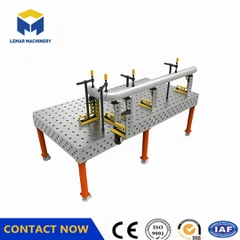
For example, a D28 3D Fixture Welding Table may be equipped with sophisticated clamping mechanisms and automated positioning systems that require in - depth understanding to operate safely and efficiently. Inadequate training can lead to errors, equipment damage, and safety hazards.
4. Dependence on Power and Infrastructure
Special welding platforms are heavily reliant on a stable power supply. Any power disruptions, such as blackouts or voltage fluctuations, can interrupt the welding process, leading to defective welds and wasted materials. Additionally, some platforms require a specific type of power source, such as three - phase electricity, which may not be available in all manufacturing facilities.
Furthermore, the physical infrastructure of the manufacturing plant needs to be suitable for these platforms. They often require a large and level space for installation, and proper ventilation is necessary to remove welding fumes, which are hazardous to workers' health. If the existing infrastructure cannot meet these requirements, significant modifications may be needed, adding to the overall cost and complexity of integrating the platform.
5. Compatibility with Existing Equipment
Integrating a special welding platform into an existing manufacturing setup can be challenging due to compatibility issues. The platform may not be compatible with the company's existing welding machines, tooling, or control systems. For example, if a company has been using a particular welding power source and wants to switch to a new special welding platform, the new platform may require a different type of power source or communication protocol, making it difficult to integrate without significant changes to the existing equipment.
Similarly, the tooling and fixtures used on the old welding stations may not fit or work properly on the new platform. This can force companies to invest in new tooling and fixtures, further increasing the cost of adoption.
6. Long Lead Times for Customization
When a company requires a special welding platform with custom features or specifications, the lead time for production can be quite long. Designing and manufacturing a custom - built platform involves a series of steps, including concept design, prototyping, testing, and final production. Each step takes time, and any design changes during the process can further delay the delivery of the platform.
For instance, a manufacturer may need a Modular 3D Welding Tables with a unique configuration to meet the specific requirements of a new project. The customization process may take several months, which can be a problem if the project has a tight deadline.
Conclusion
While special welding platforms offer numerous advantages in terms of precision, efficiency, and repeatability, they also face several limitations. These limitations, including high costs, limited flexibility, technical complexity, power and infrastructure dependence, compatibility issues, and long customization lead times, need to be carefully considered by manufacturers before making a purchase decision.
However, it's important to note that these limitations do not necessarily outweigh the benefits. With proper planning, investment, and training, many of these challenges can be mitigated. As a supplier, I am fully aware of these limitations and work closely with customers to find solutions that meet their specific needs. Whether it's recommending the most suitable platform, providing comprehensive training, or helping with integration, my goal is to ensure that customers can make the most of these powerful tools.


If you are interested in learning more about our special welding platforms or would like to discuss potential solutions for your welding needs, I invite you to reach out and initiate a procurement discussion. We are committed to working with you to overcome the limitations and achieve your manufacturing goals.
Send Inquiry