


What is the modulus of elasticity of a flat washer?
Jun 04, 2025
Leave a message
Hey there! As a flat washer supplier, I often get asked about all sorts of technical details regarding flat washers. One question that pops up quite frequently is, "What is the modulus of elasticity of a flat washer?" Today, I'm gonna break this down for you in a way that's easy to understand.
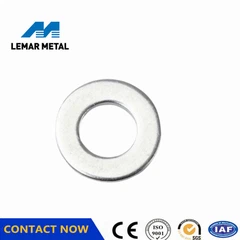
First off, let's quickly go over what flat washers are. Flat washers are simple yet incredibly useful little components. They're thin, flat disks with a hole in the middle, and they're used in all sorts of applications, from construction projects to machinery. You can find them in different materials, like steel, stainless steel, and even plastic. For instance, we offer Black Flat Washer, 304 Stainless Steel Flat Washers, and Stainless Steel Square Plate Washers. Each type has its own unique properties and uses.
Now, let's dive into the modulus of elasticity. The modulus of elasticity, also known as Young's modulus, is a measure of how stiff a material is. In simpler terms, it tells you how much a material will stretch or compress when you apply a force to it. It's a really important property when it comes to flat washers because it affects how they'll perform under different loads.
When a flat washer is under a load, it'll either compress or stretch depending on the force applied. The modulus of elasticity helps us predict how much deformation will occur. A high modulus of elasticity means the material is stiffer and will deform less under a given load. On the other hand, a low modulus of elasticity indicates that the material is more flexible and will deform more easily.


Let's take a look at how the modulus of elasticity varies for different materials used in flat washers.
Steel Flat Washers
Steel is one of the most common materials for flat washers. It's strong, durable, and relatively inexpensive. The modulus of elasticity for steel typically ranges from about 200 GPa (gigapascals) to 210 GPa. This high value means that steel flat washers are quite stiff and can handle a lot of load without significant deformation. That's why they're often used in heavy - duty applications where a lot of force is involved, like in construction equipment or automotive engines.
Stainless Steel Flat Washers
Stainless steel is another popular choice, especially when corrosion resistance is a concern. The modulus of elasticity for stainless steel is similar to that of regular steel, usually around 190 - 200 GPa. While it's slightly lower than pure steel, it still offers good stiffness and can withstand a decent amount of load. Our 304 Stainless Steel Flat Washers are great for applications where you need both strength and corrosion protection, like in marine environments or food processing equipment.
Plastic Flat Washers
Plastic flat washers are used in applications where you need a non - conductive or lightweight option. The modulus of elasticity for plastic can vary widely depending on the type of plastic. For example, polycarbonate has a modulus of elasticity of around 2.3 - 2.4 GPa, which is much lower than steel or stainless steel. This means that plastic flat washers are much more flexible and will deform more easily under load. They're often used in electronics or other applications where a small amount of flexibility is actually beneficial.
So, why does the modulus of elasticity matter when choosing a flat washer? Well, it all comes down to the application. If you're working on a project where you need a washer that can handle a lot of load without deforming, you'll want to go for a material with a high modulus of elasticity, like steel or stainless steel. On the other hand, if you need a washer that can absorb some shock or is more flexible, a plastic washer might be the way to go.
Let's say you're building a bridge. You're gonna need flat washers that can handle the massive weight and stress of the bridge structure. In this case, steel or stainless steel washers with their high modulus of elasticity are the obvious choice. But if you're assembling a delicate electronic device, a plastic washer might be better because it won't damage the components and can provide a bit of cushioning.
Another thing to consider is how the modulus of elasticity can affect the lifespan of a flat washer. A washer that's constantly being deformed beyond its elastic limit (the point where it won't return to its original shape) will eventually fail. So, choosing a washer with the right modulus of elasticity for the application can help ensure that it lasts as long as possible.
We've been in the flat washer business for a while, and we know how important it is to choose the right washer for the job. That's why we offer a wide range of flat washers in different materials and sizes. Whether you need a Black Flat Washer for a simple DIY project or Stainless Steel Square Plate Washers for a heavy - duty industrial application, we've got you covered.
If you're still not sure which flat washer is right for your project, don't hesitate to reach out. Our team of experts is always here to help you make the best choice based on your specific needs. We can provide you with detailed information about the modulus of elasticity and other properties of our washers.
So, if you're in the market for high - quality flat washers, get in touch with us. We're ready to assist you with your procurement needs and ensure that you get the perfect washers for your project. Whether it's a small - scale job or a large - scale industrial project, we can offer the right solutions.
References
- "Materials Science and Engineering: An Introduction" by William D. Callister Jr. and David G. Rethwisch
- "Mechanical Design Handbook" by Robert C. Juvinall and Kurt M. Marshek
Send Inquiry