

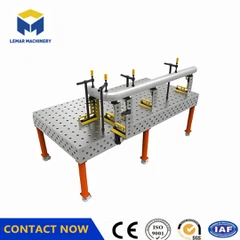




Common Faults of 3D Welding Tables
Dec 15, 2025
Leave a message
I. Mechanical Wear and Deformation
Fatigue Damage: Microscopic cracks develop within the material after prolonged use, leading to failure.
Wear: Particles detach from the surface of moving parts (such as bearings and guide rails), affecting accuracy.
Platform Deformation: Excessive load or impact causes unevenness on the working surface, requiring correction or replacement.
II. Environmental and Operational Factors
Temperature Fluctuations: Temperature fluctuations exceeding ±0.5℃/h may cause thermal deformation.
Vibration Interference: External vibrations (such as those from air compressors) are transmitted to the table surface, requiring vibration isolation measures.
Operational Errors: Such as inaccurate TCP (welding torch center point) calibration or assembly deviations.
III. System and Maintenance Issues
System Errors: Manufacturing or installation errors in machine tools, cutting tools, etc.
Insufficient Maintenance: Lack of regular cleaning, lubrication, or calibration accelerates equipment aging.
IV. Other Faults
Electrical Faults: Such as motor overload or sensor malfunction.
Software Faults: Program errors or system crashes.

Send Inquiry