



How to control environmental factors for 3D welding tables?
Dec 10, 2025
Leave a message
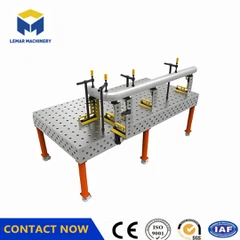
1. Ambient Temperature Control: The 3D welding table needs to operate in a constant temperature environment (recommended 20±2℃), with temperature fluctuations ≤±0.5℃/h. High temperatures can cause thermal deformation, while low temperatures may induce material brittleness. A stable temperature field can be achieved through air conditioning systems or isolating heat sources (such as lasers and motors).
2. Vibration Isolation Measures: External vibrations (such as air compressors and other equipment) can be transmitted through the ground, affecting positioning accuracy. The following measures should be taken: Active vibration isolation: Use an active vibration isolation table (such as the TS-C30 series) to effectively isolate vibrations within the 1.2-300Hz frequency range.
Passive vibration isolation: Install anti-vibration pads or an independent foundation to reduce low-frequency vibration interference.
3. Humidity Management: The humidity of the welding environment should be ≤90%. High humidity can easily lead to hydrogen porosity defects or circuit failures. If the humidity exceeds the standard, a molecular sieve dehumidifier or condenser should be used for real-time control.

Send Inquiry