

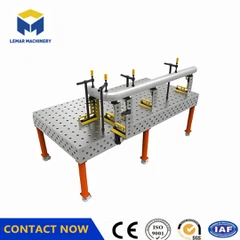




How to determine if a 3D welding worktable is deformed?
Mar 11, 2026
Leave a message
I. Judging through welding performance (indirect but practical)
The following phenomena during the welding process may indicate that the worktable has deformed:
1. Decreased weld bead consistency: Multiple runs of the same program may result in inconsistent weld bead positions or formations, especially if the first layer of weld deviates from the predetermined trajectory, indicating a change in the reference plane.
2. Uneven local penetration or increased spatter: The welding torch is too close or too far from the worktable in certain areas, causing changes in current density and unstable weld pool control. This is commonly seen in areas of local bulges or depressions on the platform.
3. Fixture repetitive positioning deviation: When using the same fixture to clamp the same workpiece, misalignment occurs in the assembly position, making it difficult to align bolts with holes, reflecting a distortion of the platform's hole system reference plane.
II. Judging through geometric inspection (direct and accurate)
Combining professional measurement methods can quantitatively assess the degree of deformation:
1. Multi-point inspection with an electronic level: Place measuring points at the center and four corners of the platform. If the difference in readings at each point exceeds 0.05 mm/m, it indicates tilting or distortion.
2. 3D Scanning Comparison of Design Model: A handheld laser scanner acquires actual surface point cloud data, which is compared with the original CAD model to generate a deviation cloud map, visually displaying the deformation area and magnitude.
3. Coordinate Measuring Machine (CMM) Inspection: High-precision coordinate acquisition is performed on key positioning holes or reference surfaces. A warning is issued if the spatial error exceeds ±0.1mm. Suitable for high-precision scenarios.
4. Laser Tracker Large-Dimensional Measurement: Suitable for large welding platforms, achieving ±10μm accuracy measurement within a range of over 10 meters, capturing the overall deformation trend in real time.
III. Special Deformation Characteristics under High-Temperature Conditions (For Dyeing Machine Scenarios): Because the equipment you maintain operates in a high-temperature environment, special attention must be paid to the dynamic characteristics of thermally induced deformation:
1. Significant Difference Between Hot and Cold States: After the equipment heats up, the platform warps locally, exhibiting acceptable leveling at room temperature, but welding offset at operating temperature.
2. Non-uniform Thermal Expansion: Uneven distribution of high-temperature airflow may cause one side of the platform to expand more than the other, resulting in angular deformation or twisting.
3. Thermal stress accumulation deformation: Under long-term thermal cycling, the residual stress inside the material is redistributed, triggering slow plastic deformation.

Send Inquiry