


How to Prevent Deformation of 3D Welding Worktables?
Mar 13, 2026
Leave a message
I. Material Selection: Enhancing the Body's Resistance to Deformation
Using highly stable materials is fundamental to preventing deformation:
Prioritize HT300 cast iron or low-alloy steel (such as Q345). These materials undergo overall heat treatment, resulting in low internal stress, high rigidity, and high bending strength, effectively resisting mechanical and thermal load deformation.
Key Requirements: The material must undergo stepped aging treatment to eliminate residual stress and prevent slow deformation due to stress release during long-term use.
II. Structural Design: Enhancing Rigidity and Thermal Symmetry
A reasonable structural design can reduce the risk of deformation from the outset:
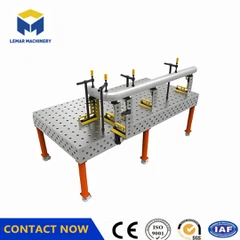
1. Gridded High-Precision Hole System Design
Use a regular hole array with φ28mm or φ16mm holes spaced at 100mm/50mm intervals. Hole position tolerance ≤ ±0.05mm ensures uniform stress distribution and avoids localized stress concentration.
2. Modular Splicing Structure
Multiple worktables can be directly connected through five surfaces to form an overall rigid frame, enhancing torsional and bending resistance, particularly suitable for welding large workpieces.
3. Symmetrical Layout of Welds and Support Points: Plan symmetrical weld paths and support positions during the design phase to offset thermal shrinkage forces and reduce angular and bending deformation.
III. Thermal Deformation Control: Key Measures for High-Temperature Operations: For the high-temperature, high-pressure air-liquid dyeing machine you are maintaining, it is crucial to prevent heat-induced deformation:
1. Hot-State Secondary Leveling Mechanism: After leveling in the cold state, re-check the platform's levelness when the equipment reaches its normal operating temperature (e.g., above 80°C) and make minor adjustments to compensate for differences in thermal expansion.
2. Installation of Heat Insulation and Temperature Equalization Devices: Install flow guides or ceramic fiber insulation panels around the platform to prevent high-temperature airflow from directly impacting localized areas and maintain a uniform temperature field.
3. Dynamic Monitoring and Feedback: Deploy temperature sensors and displacement monitoring points to track the platform's deformation trend under thermal cycling in real time, guiding preventative maintenance.
IV. Usage and Maintenance Standards: Prevent Deformation Caused by Human Factors
Improper operation is a major cause of deformation. The following standards must be strictly followed:
1. Regular Leveling and Accuracy Verification
Perform systematic leveling every 6 months using an electronic level or multi-point laser measurement to ensure flatness error ≤ 0.1mm/m.
2. Timely Removal of Workpieces
Remove workpieces immediately after welding to avoid plastic deformation caused by prolonged load.
3. Prohibition of Hard Object Impact
Never directly strike the worktable with hammers or other tools to prevent localized dents that could damage the overall structure.
4. Cleaning and Protection
Remove welding slag and oil before each use; spray anti-spatter liquid during welding to protect the hole system and surface accuracy.
V. Welding Process Optimization: Reduce External Stress Input
Reducing heat input from the process source can significantly reduce the driving force of deformation:
Use low-heat-input welding methods, such as laser-MAG hybrid welding, to reduce line energy and angular deformation.
Scientifically plan the welding sequence: Weld symmetrically from the center outwards, and use a segmented back-welding method for long welds to avoid heat concentration.
Preset reverse deformation: Set a small reverse deformation in advance during clamping to counteract welding shrinkage.

Send Inquiry