




Robotic Welding Table
Application:Welding&Assemble
Process:CNC Machining
Surface treatment:Nitrided/Normal
Type:3D
Brand:Lemar
Industry:Robotic Application

Products Description
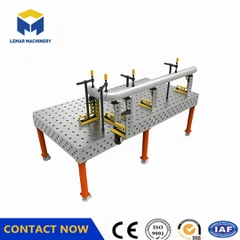
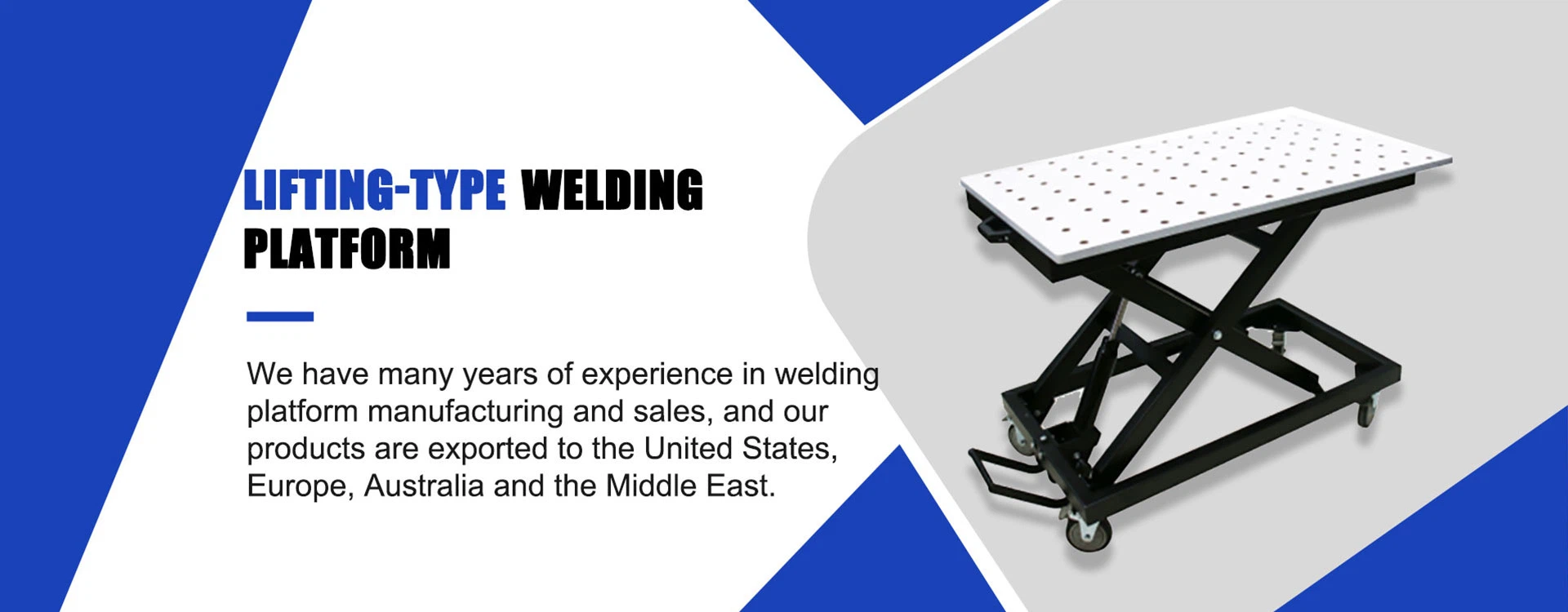
Robotic Welding Table is an integrated workbench specially designed for industrial robotic welding systems. It is not only a physical platform for carrying workpieces but also an intelligent tooling system integrating precision positioning, rapid clamping, position-changing movement, and system control functions. As a key interface between the robot and the workpiece, this platform aims to maximize the working efficiency, precision, and flexibility of the welding robot.
Cell:+86 159 952 699 47(Whatsapp/Wechat)
Evasummer@lemarmetal.com

Products Parameters


Products Application
Typical Applications
Main Applications of Robotic Welding Table:
1. Mass production of auto parts: medium-to-large batch, high-beat welding of subframes, mufflers, seat frames, battery trays, etc.
2. Welding of construction machinery structural parts: automated welding of large structural parts such as excavator booms and crane jibs.
3. Precision components for aerospace: precision welding of high-strength alloys such as landing gears and engine brackets.
4. Metal furniture and sheet metal industry: efficient and aesthetic welding of standardized products.
5. Flexible Manufacturing Cell (FMC): as the core component of the welding FMC, it cooperates with the logistics system to realize multi-variety automated production.


Products Display
Products features
Core Features

1. High Precision and Rigid Structure
• Precision Reference Plane: Robotic Welding Table surface undergoes precision milling and heat treatment, achieving high flatness (typically ≤0.1mm/m²), providing an absolute reference for workpieces and fixtures.
• Heavy-Duty Stable Structure: Adopts a box-type or frame-type reinforced design, with extremely high static and dynamic rigidity, capable of resisting high-speed movement of welding robots and vibrations and thermal deformation generated during the welding process.
• Standardized Interfaces: Usually equipped with D16 or D28 grid hole systems, matrix screw holes, or dedicated QUICK quick-change interfaces, ensuring repeatable and precise installation of positioning components.
2. Collaborative Integration with Robots
• Offline Programming Coordinate System: The platform itself or the fixtures on it are equipped with precise mechanical or visual reference points, which can accurately correspond to the virtual coordinate system in robot offline programming, greatly simplifying programming.
• Safe Collaborative Space: The design fully considers the robot's working radius, joint movement range, and anti-collision areas, optimizing the layout to maximize robot reachability.
• Signal and Communication Integration: Pneumatic/hydraulic fixtures, sensors, positioning pins, etc., on the platform can interact with the robot controller through I/O signals, realizing a fully automatic clamping and welding process.
3. Automated and Flexible Design
• Automated Tooling: Integrates pneumatic/hydraulic clamping, electric positioning, automatic centering, and other mechanisms to reduce manual intervention.
• Flexible Combination: Adopts a modular design, which can adapt to the welding of different families of workpieces in a short time by replacing standardized fixture modules or sub-boards.
• Multi-Station Design: Common dual-station or turntable designs allow the robot to weld at one station while the operator can load and unload materials at another station, achieving seamless production integration.
4. Integration of Positioning Functions
• External Axis Integration: Robotic Welding Table is often integrated with single-axis, dual-axis, or three-axis positioners (such as head-tail stock flipping, L-type positioning, tilting and rotating), enabling the workpiece to be in the robot's "golden welding position" with the optimal posture, realizing fillet welding, reducing the movement of robot axes, and improving welding quality and speed.
• Synchronized Coordinated Movement: The positioner can serve as the seventh external axis of the robot, achieving fully synchronized coordinated movement with the robot arm, used for welding complex spatial curves.

Products Certification


Robotic welding platform is the "intelligent base" and "efficiency amplifier" of modern automated welding systems. It fundamentally solves the core problem of "how to make robots work efficiently, accurately, and stably", transforming industrial robots from mere "mechanical arms" that can only execute fixed paths into intelligent production units capable of adapting to a certain range of products and independently completing the entire "positioning-clamping-welding" process.
Choosing or designing an excellent robotic welding platform is not just about purchasing a workbench, but about formulating a set of future-oriented automated welding production strategies. It needs to comprehensively consider product processes, robot selection, production takt, and flexible needs. Successful integration can enhance welding production capacity by an order of magnitude, which is a key step for manufacturing enterprises to achieve automated upgrading and build core competitiveness.
feel free to contact me for more details!↓↓↓
Cell:+8615995269947(Whatsapp/Wechat)
Email:Evasummer@lemarmetal.com
www.lemarmachine.com
Hot Tags: robotic welding table, China robotic welding table manufacturers, suppliers, factory
You Might Also Like


Send Inquiry