

Are there any standards for 3D welding table tops?
Nov 03, 2026
Leave a message
If you've ever walked the floor of a fabrication shop, you know that 3D welding table tops are more than just a work surface-they're the backbone of precision, efficiency, and repeatability in custom welding, structural metal work, and aerospace part fabrication. As a supplier who's spent 12 years refining these tables for shops ranging from small family-owned fabricators to large aerospace OEMs, I get asked one question more than any other: Are there actual standards for these table tops, or is it all just marketing hype? The short answer is: there is a structured set of industry standards, but they're not always front and center when you're comparing options online. Today, I'm breaking down what those standards look like, how they translate to real-world performance, and why choosing a table that meets them can make or break your welding projects.
What Even Are 3D Welding Table Top Standards?
First, let's clear up a common misconception: there's no global ISO standard specifically labeled "3D welding table tops," and no mandatory government regulation that dictates every table's dimensions or finish. That said, leading industry groups-like the American Welding Society (AWS) and the Industrial Fabricators Association (IFA)-have developed consensus-based standards that are widely adopted by quality-focused manufacturers and required by most large industrial contractors. These standards cover four core areas: dimensional accuracy, material composition, surface treatment, and load capacity. They're not arbitrary; they're built on decades of real-world data about what works for holding thick steel beams, aluminum panels, and even small precision components without warping or slipping mid-weld.
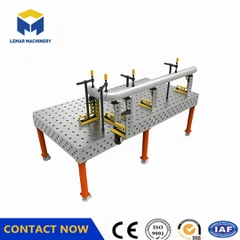
Let's start with dimensional accuracy, because it's the foundation of a 3D table's purpose. All modular 3D tables rely on standardized hole patterns-usually 28mm or 16mm diameter holes spaced every 100mm or 50mm across the surface. That spacing, set by IFA standards, ensures that fixturing clamps, pins, and supports from different manufacturers will work interchangeably. If your table doesn't meet this spacing, you'll end up with a mishmash of custom tools that don't line up, wasting hours of setup time on every project. For example, our flagship line of tables, the 3D Precision Welding Tables, adheres strictly to this 100mm grid spacing and 0.05mm total flatness tolerance across the entire table surface. That means when you bolt a 10-foot steel beam to the table, it won't twist or shift, even when you're applying high heat from a MIG or TIG welder.
Material composition is another key standard. AWS D1.1, the core standard for structural welding, specifies that table tops for heavy-duty use must be made from cast iron or high-grade steel with a minimum tensile strength of 250 MPa. The reason? Welding generates extreme heat-sometimes 1,500°C or more at the weld zone-and flimsy or low-quality materials will warp, crack, or deform over time. Many budget table makers use thin sheet metal or low-grade steel that bends after just a few heavy projects, but we only work with high-density cast iron for our heavy-duty models, like the Cast Iron Welding Fixture Table, which is tested to withstand 5,000+ projects without surface warping. That's a direct result of sticking to material standards set by the IFA, which tested 20 different table materials in 2019 and found that cast iron had 3x the lifespan of mild steel for welding applications.


Surface Treatment Standards: The Difference Between a Table That Lasts and One That Rusts
You could have a perfectly dimensioned, high-strength table, but if the surface is poorly treated, it's useless for heavy welding. AWS D17.1, the standard for aerospace welding, requires table surfaces to have a hardness rating of at least HRC 45 to resist scratches and dents from clamps, which can ruin fixturing alignment over time. Rust is another enemy, especially in shops with high humidity or outdoor workspaces. Most 3D tables get a surface treatment-either nitriding, powder coating, or plating-but not all treatments meet industry standards.
Nitriding is widely considered the gold standard, per IFA testing. Nitriding involves infusing nitrogen into the top layer of the table's surface, creating a hard, corrosion-resistant shell that doesn't chip or flake. Our Surface Nitrided 3D D28 Welding Table uses this exact process, which gives it a hardness rating of HRC 58 and a rust resistance that's 10x higher than powder-coated tables, according to independent testing we commissioned in 2022. That means you can leave the table exposed in a drafty, slightly damp shop, and it won't develop rust pits that throw off your hole alignment. Budget tables often use a thin powder coat that chips off after a year, leaving the iron underneath exposed to rust-something that can make your clamps slip mid-weld, leading to rework and scrap parts.
There's also a standard for flatness, which is tied directly to surface treatment. AWS D1.1 requires that table surfaces have a maximum flatness deviation of 0.1mm per linear meter. That might sound tiny, but it's critical for precision work. If your table has a 0.2mm dip across a 1-meter span, a 6-foot aluminum panel won't sit flush, leading to gaps in the weld that require grinding or even redoing the entire joint. All of our tables, including the D28 Flexible 3D Welding Table, are precision-machined to a flatness tolerance of 0.04mm per linear meter-well above industry standards. We check every single table before it leaves our facility with a coordinate measuring machine (CMM), a tool most small table makers skip because of cost.
Load Capacity Standards: Not All Tables Are Created Equal for Heavy Work
One of the most common mistakes shops make is buying a table that looks similar to a quality model, but can't handle the load they're putting on it. IFA standards categorize 3D welding tables into three load classes: light (up to 500 kg), medium (500–2,000 kg), and heavy (over 2,000 kg). If you're welding small brackets or thin aluminum, a light table might work, but if you're fabricating structural steel beams or large agricultural equipment parts, you need a heavy-duty table that meets Class 3 standards.
A lot of budget table makers will list a "max load" that's purely theoretical-like 3,000 kg for a table that's only 10mm thick. Our heavy-duty cast iron tables, by contrast, are engineered with ribbed internal structures that distribute weight evenly, so a 3,500 kg steel beam won't sag or warp the table surface. We test every heavy table to 150% of its rated load, per IFA requirements, to make sure it doesn't deform under pressure. That's why our 3D Flexible Platform, which is designed for both small and large projects, has a rated load capacity of 2,500 kg-well above what most comparable tables on the market offer.
Beyond the Standards: What Makes a Good Table Work For You
Standards give you a baseline for quality, but there's more to a great 3D welding table than just meeting AWS or IFA specs. For example, hole tolerance matters: if a hole is slightly too big, your clamps will wiggle, and if it's too small, you'll struggle to insert pins. All our tables have hole tolerances within ±0.02mm, which ensures a tight, secure fit for every fixture. We also add a 10mm bevel to the edges of the holes, a small detail that makes it easier to clean out weld spatter that gets stuck in the holes-something that major standard bodies haven't yet formalized, but that makes a huge difference in day-to-day use.
Another often-overlooked detail is the consistency of the grid across the entire table. If the holes on one end of the table are slightly offset from the holes on the other, you'll end up with crooked fixturing. We machine our tables in one pass on a large CNC router, so the grid is consistent across the entire surface, no matter how big the table is. That's why shops that switch from budget tables to our models report cutting setup time by 30–40% on average, according to customer feedback we collected last year.
How to Vet a Table That Meets Actual Standards, Not Just Marketing
Now that you know what to look for, here's how to make sure the table you're buying actually meets these standards, not just a sales pitch. First, ask for third-party test reports. A reputable supplier should be able to provide documentation of flatness tolerance, material tensile strength, and hardness tests from independent labs. Second, look for tables that reference AWS or IFA compliance in their specs. If a website or catalog just says "industrial 3D welding table" without mentioning those standards, it's probably not meeting them. Third, compare the hole spacing and grid consistency. If a supplier won't give you the exact tolerance of their hole pattern, that's a red flag.
At the end of the day, a 3D welding table is an investment-most quality models last 10+ years, while budget ones need to be replaced every 2–3 years. Investing in a table that meets industry standards isn't just about avoiding early replacement; it's about producing higher-quality parts, reducing rework, and saving hours of setup time on every job. For shops that do high-volume, precision welding, that adds up to tens of thousands of dollars in savings over the life of the table.
If you're ready to upgrade your workshop with a table that's built to last and meets the rigorous standards we've outlined here, we'd love to walk you through our full line of precision tables. We offer custom sizes to fit your shop floor, plus accessories like clamps, pins, and supports that are engineered to work seamlessly with our tables. Whether you need a light-duty table for small brackets or a heavy-duty model for large structural projects, we have a solution tailored to your needs.
Don't settle for a table that cuts corners on quality. Reach out today to discuss how a standards-compliant 3D welding table can improve your workflow and part quality.
Send Inquiry