

Can I use a steel table top for Tig welding?
Nov 03, 2026
Leave a message
If you've ever fired up a TIG welder and stared at a table top that's been used for other jobs, you've probably wondered: can I just use a steel table top for TIG welding? I get it-when you're setting up a workspace, cost and convenience are top of mind, and a basic steel table seems like a no-brainer. But after years in the TIG welding table top game, I've seen both the wins and the headaches that come with skipping a dedicated setup. Let's break this down, from the science of steel vs. proper welding surfaces to why the right table matters for your projects.


First, let's get the basics of TIG welding out of the way. TIG (Tungsten Inert Gas) welding uses a non-consumable tungsten electrode, a shielding gas (usually argon), and a filler metal to create clean, precise welds. Unlike MIG welding, which is a bit more forgiving of surface conditions, TIG is super sensitive to contamination-even tiny bits of rust, oil, or stray weld spatter can ruin a weld. That's why the table you weld on isn't just a flat surface to hold your part; it's a critical part of your TIG setup.
So, what's the deal with a regular steel table? Let's talk about the two main types of steel you'd run into here: mild steel and stainless steel. Mild steel is cheap, ubiquitous, and easy to find at any hardware store. A mild steel table top might seem like a great budget move, but it has some big downsides for TIG. For one, mild steel is porous, so it holds moisture and oil from manufacturing or storage. When you hit that surface with a TIG arc (which can reach 10,000°F or more), those contaminants vaporize and get trapped in your weld pool, causing porosity-tiny holes that weaken the weld. Even worse, the heat from TIG can warp mild steel fast. A 1/4-inch mild steel table might hold up for small jobs, but a big, thick part you're welding for an hour will make that table bow, messing up your part alignment mid-job.
Stainless steel table tops are a step up, right? They're corrosion-resistant and don't warp as easily as mild steel. But here's the catch: stainless steel has high thermal conductivity, which pulls heat away from your TIG arc faster than you'd think. If you're welding thin materials (like 16-gauge sheet metal, super common in TIG work), that extra heat loss makes it way harder to get a clean, consistent bead. You might end up blowing through the metal or having to crank your amperage way up, which defeats the precision TIG is known for. Also, stainless steel can leave behind chromium contamination if a TIG arc strikes it directly- that discolors your tungsten electrode and can even transfer into your next weld, leading to discoloration or weak spots.
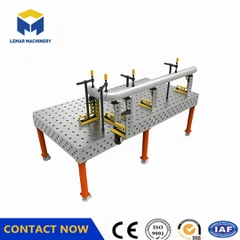
Now, let's get into the alternative: a dedicated TIG welding table top. Wait, but why not just buy a random table? Because good welding tables aren't just flat metal. They're built with features that solve exactly the problems I mentioned earlier. Let's talk about cast iron, for example. A lot of high-quality welding tables use cast iron because it has low thermal conductivity compared to steel. That means your TIG arc's heat stays where you want it, so you get a clean bead without fighting constant heat loss. Cast iron is also super rigid-you can clamp down thick parts, weld all day, and the table won't warp, even on big projects. But not all cast iron tables are the same. For TIG, you want one with a proper rust-prevention coating, right? Regular cast iron will rust fast if you're working in a damp garage or even just sweating a bit during a long weld. That's why our Rust Prevention 3D Welding Table System is a game-changer-it's designed to stand up to the heat, moisture, and spatter that come with TIG, so you don't have to stress about rust ruining your table mid-job.
Wait, let's circle back to steel for a second. Is there any scenario where a steel table works for TIG? If you're only doing occasional, small TIG welds on thick, sturdy material, and you're fine with prepping the table every single time-like sanding it down to get rid of rust, degreasing it with acetone, and covering it with a steel plate or welding blanket to block spatter-then maybe. But that's a ton of extra work. I've had new welders come to us saying they used a steel table for a week, only to realize they spent more time cleaning their table than actually welding. That's not efficient, and it's easy to skip a step here or there, leading to bad welds.
Another thing to consider: workholding. TIG often requires very precise alignment-you can't have your part shifting mid-weld. A basic steel table is usually just a flat surface with no holes or slots to clamp into. A good TIG welding table has a grid of precision holes (usually 5/8-inch, industry standard) that let you clamp parts at any angle, hold them steady, and adjust on the fly. That's where 3D welding tables shine-you can set up complex fixtures fast, without fumbling with makeshift clamps or holding parts by hand. Our Metal Fab Welding Table is built exactly for that, with a durable surface that works for TIG, MIG, and even CNC work if you need it.
I also want to address a common myth: some people think a steel table is conductive, which is bad for TIG. TIG uses a separate ground clamp on your part, right? So the table itself shouldn't be part of the circuit-unless you accidentally touch the electrode to the table while welding. That's called striking the arc on the table, and it's bad news for both the tungsten and the table. On a steel table, that arc can leave a hard, pitted spot that's almost impossible to sand out, and the heat can warp the steel. On a cast iron table, that pitting is even worse? Wait, no-wait, actually, modern welding tables are coated to resist that spatter and arc strikes. Our Multi Functional Welding Platform is made with a tough, spatter-resistant finish that lets you wipe off stray weld bits with a wire brush, no sanding needed, even if you do accidentally strike an arc.
Let's talk about long-term costs, too. A cheap mild steel table might set you back $100, but if you have to replace it every 6 months because it warps or rusts, plus the money you waste on bad welds that need reworking, that's way more than investing in a proper TIG welding table top up front. Our 3D Cast Iron Flexible Welding Platform is built to last a decade or more, even with daily TIG use. It's rigid, resists warping, and the rust-preventive coating means you don't have to store it in a climate-controlled space-perfect for guys who work out of a garage or shop that's not temperature-controlled.
I've seen so many welders make the mistake of grabbing a random steel table to save a few bucks, only to regret it later. Let me give you a real example: a customer a few months back came to us frustrated because he was TIG welding custom bike frames out of 1-inch chromoly, and his steel table was warping so bad he couldn't get the frame straight. He was spending hours trying to bend the table back into shape, and his welds were inconsistent because of the shift. We helped him get a Rust Prevention 3D Welding Table System, and he told me a month later that he's now finishing jobs 2x faster, his welds are cleaner, and he no longer spends his weekends fixing his table instead of welding.
Wait, I should also mention that if you're set on using steel, there are workarounds, but they're not perfect. Like, you can put a thick steel plate on top of your table for TIG jobs. But that plate still has to be prepped every time, and it will warp over time too. Or you can use a TIG welding pad, but those are for small jobs, not big parts. The bottom line is: a dedicated TIG welding table is designed to eliminate those headaches, not add more work.
So, to answer the original question: yes, you can use a steel table top for TIG welding, but it's not ideal for most people. If you're doing occasional small jobs and willing to put in the extra work to prep the table every time, it might work. But for anyone doing regular TIG work, wanting cleaner welds, less downtime, and a table that lasts, a proper TIG welding table top-whether it's our cast iron options like the Cast Iron Welding Fixture Table or our steel-based Metal Fab Welding Table- is worth the investment.
At the end of the day, your table is your workhorse. It's not something you want to cut corners on. If you're tired of warped tables, bad welds, and endless cleaning, let's chat about what setup works best for your shop. Whether you're a hobbyist doing weekend projects or a pro running a full metal fab shop, we can help you pick the right table that fits your needs and budget. Reach out today to connect and find the perfect solution for your TIG welding needs.
Send Inquiry