

How long is the service life of a modular flexible welding table?
Nov 02, 2026
Leave a message
If you've ever spent time in a welding shop, you know the value of tools that don't just work for a single project-tools that adapt, hold up to heavy use, and don't need replacing every few years. As a supplier of modular flexible welding tables, one of the most common questions I get from welders, fabrication shop managers, and small business owners is: "How long is the service life of a modular flexible welding table?" It's a fair question, too. Welding tables take a beating: they stand under heavy workpieces, endure high heat from arcs, get exposed to spatter and grinding debris, and are reconfigured dozens (if not hundreds) of times a year for different projects. In my years working with fabricators across industries, I've seen both well-crafted modular tables last for decades and cheaply made ones fail in just a couple of years. The difference isn't just luck-it's in design, materials, how it's used, and the care it gets. Today, I want to break down what determines a modular flexible welding table's service life, share what we've learned from our own products, and give you a clear picture of what to expect when investing in this kind of equipment.
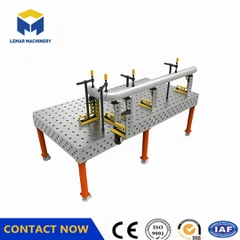
First, let's get clear on what a modular flexible welding table is, because not all tables labeled this way are the same. These tables aren't the old-fashioned flat metal slabs welded to a frame; they're made up of standard, repeatable components-slats, holes, fixture points, and interchangeable clamps-that let you adjust the table's layout for any project, from a small bracket to a large structural steel assembly. That flexibility is their biggest advantage, but it also means their service life depends on more parts than a stationary, single-purpose table. When we design our tables, we start with core material choices, because that's the foundation of how long it will last. A lot of budget modular tables are made from low-carbon steel with a basic paint finish. Paint can chip easily from repeated clamp adjustments or heavy workpieces, leaving the steel exposed to rust. Welding spatter also sticks to cheap steel more, and grinding debris can scratch the surface deeply over time. Our Surface Nitrided 3D D28 Welding Table is built with a surface nitriding treatment that changes the top layer of the steel to be extremely hard and corrosion-resistant. That means it doesn't scratch as easily, spatter wipes off without sticking, and rust is barely a concern even after years of exposure to shop conditions. From what we've tracked, tables with this kind of surface treatment easily outlast tables with paint or powder coat finishes by a factor of two or three.
Next, the design of the table's core structure matters a lot. Modular tables are supposed to be flexible, but if the base frame or the slats bend under the weight of a heavy workpiece, that flexibility becomes a problem. Imagine setting up a fixture for a 500-pound steel beam, and the table slats sag so the beam tilts-your welds won't be straight, and you're risking damage to the table itself. When we engineer our 3D Welding Table System, we calculate load capacities for every component, not just the whole table. The slats are made from thick, high-tensile steel, and the frame is reinforced so it can hold heavy loads without deforming. I've had customers tell us their first modular table was a "no-name" import that bent after just six months of use on medium-sized projects. They traded it in for our system, and three years later, it's still as rigid as the day they bought it. That kind of durability doesn't happen by accident; it's about designing for the actual use cases fabricators face, not just a spec on a paper.
But here's the thing about modular tables: their service life isn't just about the table itself-it's about the fixtures and accessories that come with it, too. A welding table is only as good as the clamps, pins, and jigs you use with it, and those parts take as much wear as the table surface. Our 3D Flexible Welding Table With Fixture includes fixtures made from the same high-strength steel as the table, designed to lock into place securely without stripping threads or bending. I've seen shops that mix cheap, generic clamps with premium tables, and within a year, those clamps break or slip, forcing the shop to replace them constantly. That adds up to a lot of hidden costs over time, and it shortens the overall useful life of the table system, because you can't use the table's full flexibility if your fixtures fail. When you invest in a complete, integrated 3D Flexible Welding Table, you avoid that problem. The fixtures are tested to work seamlessly with the table's slat holes and clamp points, so every adjustment is smooth, and parts don't wear out prematurely.
Now, let's talk about how use and maintenance play into this, because even the best table will fail early if it's mistreated. Welding spatter is the biggest enemy of any welding table. If you leave spatter to cool and harden on the surface, when you adjust clamps or move fixtures, you can scratch the table's surface, and over time, that can lead to rust. Regular cleaning is simple-we recommend using a wire brush or a spatter removal tool once a week to wipe the table down, and using a light oil or anti-spatter spray to prevent spatter from sticking. For our nitrided tables, cleaning is even easier; the hard, smooth surface means spatter can often be brushed off without any chemicals. Another common mistake is overloading the table. Each modular table has a specified weight capacity, and exceeding that not only risks warping the slats or frame but also can damage the connection points where fixtures lock in. I had a customer once who crammed three large workpieces onto his table to save time, and within a month, two of the slats had bent so bad they couldn't hold fixtures properly. Simple habits like not exceeding load limits and cleaning the table regularly can add years to a table's service life.
From our experience with customers, a well-maintained modular flexible welding table should last anywhere from 15 to 25 years. That's a big range, I know, but it depends on how it's used. For a small fabrication shop that uses the table for 40 hours a week on medium-sized projects, sticking to load limits and cleaning weekly, that table will easily hit 20 years or more. For a high-volume shop that runs two shifts a day, works on very heavy parts, and might skip maintenance during busy periods, you might see 10 to 15 years of reliable use, and even then, most of those tables can be repaired or refurbished instead of replaced. The slats and fixtures, for example, can be replaced individually if they get damaged, instead of having to buy an entirely new table. That's one of the biggest advantages of modular design-you don't have to throw the whole system away because one part wears out.
I want to be honest here: some of the cheaper modular tables on the market claim service lives of 10 years or more, but that's rarely the case. Those tables are often made from thin steel, with basic surface treatments that wear out after a couple of years, and their fixtures are made from soft steel that strips or bends easily. I've had customers come to us after buying a budget table that was already rusted and bent after two years, and they had to spend more on our table than they would have initially to get a reliable product. When you look at the total cost of ownership, a high-quality modular table that lasts 20 years is a much better investment than a cheap one that needs replacing every 5 years. Not only do you avoid the cost of a new table every few years, but you also save on downtime-changing tables means reconfiguring all your fixtures, adjusting your workflow, and delaying projects, which adds up to real money for any business.
Another thing to consider is the adaptability of the table itself, because that affects how long it remains useful, which is part of its "service life" in a practical sense. A modular table that can be reconfigured for new projects, new materials, or new welding techniques will stay useful for much longer than a table that's only good for one type of job. Our Three Dimensional Flexible Welding Platform is designed to grow with your business. If you start with small brackets, you can add extension slats to work on larger parts like trailers or structural beams, or adjust the fixture kit to accommodate new welding processes like MIG, TIG, or even robotic welding. A table that can adapt to changes in your business doesn't just last longer physically-it stays valuable for longer, so you get a better return on your investment.


I've seen this play out firsthand with a customer of ours who runs a custom metal fabrication shop in the Midwest. They bought one of our 3D flexible welding tables 18 years ago for small farm equipment repairs. Over the years, they added slats to work on larger agricultural trailers, upgraded to fixtures that fit their new TIG welding setup, and even adapted parts of the table for their new robotic welding arm. Today, that table is still their main workhorse, and they only had to replace a few individual slats and one set of fixtures when they switched to robotic welding. When they told me that, I knew it was exactly what modular tables are supposed to do: grow with your business, last through changing needs, and deliver reliable performance for decades.
Of course, no table lasts forever, even the best one. Eventually, wear and tear will catch up, and you'll have to decide whether to refurbish or replace it. The good news is that with modular design, refurbishing is often a viable option. You can replace worn slats, upgrade your fixtures, or even add new modules to the table to meet your current needs, instead of starting over. That's another reason why investing in a quality modular flexible welding table is a smart choice-it's not a disposable tool, it's a long-term asset for your shop.
If you're in the market for a modular flexible welding table, don't just look at the brand name or the upfront price. Ask about the materials used in the table and fixtures, the load capacity, and the service life the manufacturer stands behind. Consider your shop's specific needs: how heavy are your workpieces, how many projects do you run in a week, and do you plan to adapt your welding setup in the future? A table that fits those needs will give you the longest service life and the best value.
At the end of the day, the service life of a modular flexible welding table isn't a number you can pull out of thin air-it's a combination of quality engineering, durable materials, smart use, and regular maintenance. When you choose a well-made table, invest in its care, and adapt it to your needs, you're looking at a tool that will be part of your shop for 15, 20, even 25 years. That's the kind of reliability every welding business needs, and that's what we design our tables to deliver.
If you're ready to find a modular flexible welding table that fits your needs and will stand the test of time, we can help. Our team has worked with fabricators of all sizes, from small shops to large industrial facilities, to find the right table and fixtures for their projects. Whether you're just starting out or looking to upgrade your current setup, we can walk you through the options, answer your questions, and help you make an investment that will pay off for years to come. Don't settle for a table that will need replacing in a couple of years-invest in a quality modular welding table that will grow with your business and keep your projects running smoothly for decades.
Send Inquiry