




Can a 2D welding table improve welding precision?
Oct 04, 2026
Leave a message
In the world of welding, precision is paramount. It can mean the difference between a successful weld that meets exacting standards and one that falls short, potentially leading to structural failures or subpar products. As a supplier of 2D Welding Tables, I've witnessed firsthand the transformative impact these tables can have on welding precision. In this blog, I'll delve into the question: Can a 2D welding table improve welding precision?
Understanding the Basics of 2D Welding Tables
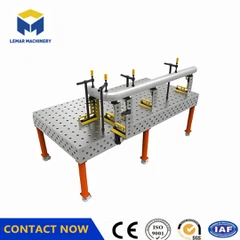
Before we explore the impact on precision, let's first understand what a 2D welding table is. A 2D welding table is a flat, rigid surface designed specifically for welding operations. It typically features a grid pattern of holes or slots that allow for the attachment of various clamping devices, fixtures, and jigs. This modular design provides a high degree of flexibility, enabling welders to secure workpieces in place with precision and stability.
There are several types of 2D welding tables available on the market, each with its own unique features and benefits. For example, the D16 Hole Welding Clamping Table is a popular choice among welders due to its standard D16 hole size, which provides a versatile and reliable mounting system for a wide range of clamping devices. The Flexible Welding Bench, on the other hand, offers even greater flexibility with its adjustable height and tilting capabilities, allowing welders to optimize their working position for maximum comfort and precision.
How 2D Welding Tables Improve Welding Precision
Now, let's address the question at hand: How do 2D welding tables improve welding precision? There are several key factors at play here.
1. Workpiece Stability
One of the primary ways a 2D welding table improves precision is by providing a stable platform for the workpiece. When a workpiece is securely clamped to the table, it is less likely to move or shift during the welding process. This stability is crucial for maintaining consistent weld quality, as even the slightest movement can result in uneven welds, poor penetration, or other defects.
The grid pattern of holes or slots on a 2D welding table allows for the use of a variety of clamping devices, such as C-clamps, vise grips, and magnetic clamps. These clamps can be positioned precisely to hold the workpiece in place, ensuring that it remains stationary throughout the welding process. Additionally, some welding tables feature built-in T-slots or dovetail grooves, which provide even more secure mounting options for fixtures and jigs.
2. Accurate Positioning
Another important aspect of welding precision is accurate positioning of the workpiece. A 2D welding table makes it easier to position the workpiece in the desired location and orientation, thanks to its grid pattern and reference markings. Welders can use these markings to align the workpiece precisely, ensuring that the welds are placed exactly where they need to be.
In addition to the grid pattern, many 2D welding tables also feature adjustable stops and guides, which can be used to further improve positioning accuracy. These stops and guides can be set to specific dimensions, allowing welders to repeat the same setup for multiple workpieces, ensuring consistency and precision across the entire production run.
3. Improved Accessibility
A 2D welding table also improves welding precision by providing better accessibility to the workpiece. When a workpiece is securely clamped to the table, welders have easier access to all sides of the workpiece, allowing them to make more accurate and consistent welds. This is particularly important for complex or intricate welding projects, where access to hard-to-reach areas can be a challenge.
The modular design of a 2D welding table also allows for the use of additional accessories, such as welding arms, torches, and fume extraction systems. These accessories can be easily attached to the table, providing welders with the tools they need to perform their work safely and efficiently.
4. Reduced Distortion
Welding can cause distortion in the workpiece, which can affect the final dimensions and shape of the product. A 2D welding table helps to reduce distortion by providing a rigid and stable platform for the workpiece. When the workpiece is securely clamped to the table, it is less likely to warp or bend during the welding process, resulting in a more accurate and consistent final product.
In addition to providing a stable platform, some 2D welding tables also feature built-in cooling systems or heat sinks, which can help to dissipate heat and reduce the risk of distortion. These features are particularly useful for welding thick or heavy materials, where the heat generated during the welding process can be significant.
Real-World Examples of Improved Welding Precision
To illustrate the impact of 2D welding tables on welding precision, let's take a look at some real-world examples.


Example 1: Manufacturing of Metal Frames
A metal fabrication company was experiencing issues with the precision of their metal frames. The frames were being welded by hand, and the welds were often uneven and inconsistent, resulting in frames that did not fit together properly. The company decided to invest in a 2D welding table to improve the precision of their welding process.
After implementing the 2D welding table, the company noticed a significant improvement in the quality of their welds. The frames were now being welded with greater precision and consistency, resulting in a better fit and a more professional appearance. The company was also able to reduce the amount of rework and scrap, which saved them time and money.
Example 2: Welding of Automotive Components
An automotive manufacturing company was using a traditional welding bench to weld automotive components. The bench was not very stable, and the components often moved or shifted during the welding process, resulting in poor-quality welds. The company decided to switch to a 2D welding table to improve the precision of their welding process.
After implementing the 2D welding table, the company noticed a significant improvement in the quality of their welds. The components were now being held securely in place, and the welds were more consistent and precise. The company was also able to increase their production efficiency, as they were able to weld more components in less time.
Other Types of Welding Tables and Their Impact on Precision
In addition to 2D welding tables, there are also other types of welding tables available on the market, such as 3D welding tables and robot welding tables. Let's take a look at how these tables compare to 2D welding tables in terms of their impact on welding precision.
3D Welding Tables
3D welding tables, such as the D28 Welding Table and the Grid Welding Fixture Table, offer even greater flexibility and precision than 2D welding tables. These tables feature a three-dimensional grid pattern of holes or slots, which allows for the attachment of fixtures and jigs in multiple planes. This makes it possible to weld complex or irregularly shaped workpieces with greater precision and accuracy.
However, 3D welding tables are typically more expensive and complex to use than 2D welding tables. They also require more space and may not be suitable for all types of welding applications.
Robot Welding Tables
Robot welding tables, such as the Robot Welding Tables, are designed to be used in conjunction with robotic welding systems. These tables provide a stable and precise platform for the robot to operate on, allowing for high-speed and high-precision welding.
Robot welding tables are typically very expensive and require a significant investment in equipment and training. They are also best suited for high-volume production applications, where the cost of the equipment can be justified by the increased productivity and precision.
Conclusion
In conclusion, a 2D welding table can significantly improve welding precision by providing a stable platform for the workpiece, accurate positioning, improved accessibility, and reduced distortion. These benefits make 2D welding tables an essential tool for any welder or metal fabricator who wants to produce high-quality welds with consistent results.
If you're interested in learning more about our 2D Welding Tables or other welding equipment, please don't hesitate to contact us. We'd be happy to discuss your specific needs and help you find the right solution for your welding applications. Whether you're a professional welder or a hobbyist, we have the products and expertise to help you achieve your welding goals.
Send Inquiry