

Can a Universal Welding Table be used for copper welding?
Nov 06, 2026
Leave a message
Can a Universal Welding Table be used for copper welding? That's a question we get asked all the time here, and it's one that trips up a lot of welders who are used to working with steel, aluminum, or other more common metals. I've been selling universal welding tables for over a decade, and I've seen every type of metal come through our workshop-from thin-gauge sheet aluminum to thick carbon steel blocks. Copper is a special case, though. It's highly conductive, has a high thermal conductivity, and behaves way differently than steel when you're welding it. So can our universal tables handle that? Let's break this down, step by step, because the answer isn't a simple "yes" or "no"-it depends on a few key factors.
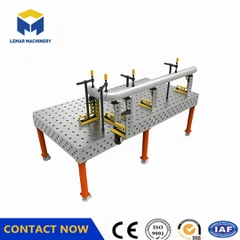
First, let's start with what a universal welding table actually is. If you've never used one, it's a modular work surface with a grid of precision-drilled holes (usually 5mm or 6mm diameter, spaced 100mm apart) that lets you clamp, fixture, and position almost any workpiece. Unlike a regular workbench, it's designed for repeatability-each hole is aligned perfectly, so you can set up a jig once and replicate it exactly later. That's why they're so popular in fabrication shops, automotive repair, and aerospace, where consistency matters more than anything. I often point new customers to our Multi Functional Welding Platform when they're looking for a base that works for multiple metals, because it's made from heavy-duty cast iron (or sometimes stainless steel, if you need corrosion resistance) and has a flatness tolerance that's within 0.5mm over 1 meter. That precision is non-negotiable when you're welding copper, because even a tiny misalignment can lead to warping or bad fit-up.
Now, copper itself. Let's talk about its properties first, because that's where the confusion starts. Copper has a thermal conductivity about 20 times higher than mild steel. What does that mean for welding? It means when you apply a heat source-like a TIG torch or MIG welder-the heat spreads out super fast through the workpiece. Unlike steel, which holds heat in a small area, copper pulls that heat away from the weld zone almost immediately. That makes it hard to get a proper melt pool, and it also means you're more likely to burn through thin copper if you don't control your heat input. On top of that, copper has a relatively low melting point (around 1085°C, compared to steel's ~1538°C) but a high coefficient of thermal expansion. So when it heats up, it expands a lot more than steel, and when it cools, it shrinks back. That warping is the biggest headache for welders working with copper. If you don't hold the workpiece firmly and evenly, it'll twist, bend, or pull apart mid-weld.
So back to the question: can a universal welding table handle this? The short answer is yes, but only if you use the right setup. Let's start with the table's material. Most universal tables are made from cast iron, which is great for rigidity, but cast iron is also highly conductive. Wait-if the table is conductive, does that matter for copper welding? I've seen welders make the mistake of clamping a copper workpiece directly to a cast iron table and then running a MIG gun without a spool gun or a ground clamp that's far enough away. What happens? The current from the welder can arc between the copper and the cast iron table, causing what's called a "stray current" arc. That'll leave pitting and small holes in both the copper and the table, and it's a safety hazard too. So if you're using a standard cast iron universal table, you can't clamp the copper workpiece directly to it. You need a non-conductive spacer-like a ceramic heat-resistant mat or a Teflon sheet-to isolate the copper from the table's surface. That's a key point a lot of new guys miss.
But wait, we also have options for people who don't want to mess with spacers. Our 3D Stainless Steel Welding Table is a great alternative here. Stainless steel is less conductive than cast iron, and it has a higher melting point, so stray current issues are way less likely. I've used this table for copper welding jobs before-last year, a customer brought in a batch of 1/8-inch thick copper busbars for a solar inverter project. We set up custom clamps on the stainless table, spaced the workpieces 20mm apart to let heat escape, and used a TIG welder with argon shielding. No warping, no arcing, and the welds came out clean. If you're doing small to medium copper parts, this is a solid choice, and you can check out more details on that via the link I mentioned earlier.
Next, the fixtures and clamps. A universal table's whole point is that you can adjust your setup to fit any workpiece, but for copper, you need more than just standard C-clamps. Warping is your enemy, so you need to apply even tension across the entire workpiece. That's why I always recommend pairing a universal table with a Welding Table With Welding Fit Up Kit. These kits come with precision clamps, hold-downs, and positioning pins that are designed to distribute pressure evenly, not just at the edges. For example, when welding two copper pipes, you can use the fit up kit's locating pins to align the ends perfectly, then use the quick-release clamps to hold them tight-no gaps, no shifting. I've also used the Adjustable Industry Welding Worktable for larger copper projects, like heat exchangers, where you need to work with multiple copper tubes at once. The adjustability lets you tilt the table to get the perfect angle for welding overhead or horizontal, which cuts down on spatter and improves weld quality.
Wait, let's talk about heat management. Even with the right table and fixtures, if you don't control heat input, you're going to have problems. Copper's high thermal conductivity means you need to use more heat than you would for steel of the same thickness, but you also need to move the weld faster to keep the heat affected zone (HAZ) small. On a universal table, you can design your fixture to include heat sinks-small copper blocks clamped to the workpiece near the weld zone-to pull excess heat away. That's a trick a lot of experienced welders use, and it works really well. Just make sure those heat sinks are clamped tightly to the workpiece, so they can absorb heat without interfering with the weld.
Now, what about limitations? A universal welding table isn't magic. If you're working with very thick copper-like 2-inch thick plates for a marine part-you might run into issues with the table's rigidity. Heavy workpieces can cause the table to flex, which will lead to misalignment during welding. For those jobs, you'd want a heavy-duty universal table, like the Fabrication Welding Fixture Table, which is built with a thicker cast iron base and reinforced legs. It can handle workpieces up to 2000kg without flexing, so you don't have to worry about welds going bad because the table moved.
Another thing to consider is shielding. Copper oxidizes really easily when it's hot, so you need a good shielding gas-argon is the standard for TIG welding copper, and argon-CO2 mixes work for MIG. But if you're using a universal table, make sure your shielding gas setup is positioned so it doesn't get pulled away by the table's design. Our Multi Functional Welding Platform has a built-in slot for gas lines, which lets you run shielding gas right to the weld zone without getting in the way of clamps. That's a small feature, but it makes a big difference in weld quality.
Let me share a real example to make this concrete. A customer of mine last year, a custom metal fabricator, asked if he could use our universal table to weld 1mm thick copper sheets for a set of decorative wall panels. He'd been using a regular steel workbench before, and every time he tried to weld, the sheets warped so bad they were unusable. We set him up with a 3D Stainless Steel Welding Table, paired with the Welding Table With Welding Fit Up Kit, and gave him a few tips: use low heat input (15A for TIG), clamp every 50mm along the edges, and place ceramic spacers between the copper and the table. He brought his panels back two weeks later-they were perfect. No warping, the welds were smooth, and he was able to finish the job a week faster than he expected. That's the power of a properly set up universal table for copper work.
I should also address a common misconception: some people think universal tables are only for steel. That's not true-they're modular, so you can adapt them for almost any metal, as long as you adjust your setup. The key is matching the table material to your copper project, using the right fixtures, and managing heat input. If you try to use a cast iron table without spacers, and you clamp the copper directly, you're going to have problems. But if you take the time to isolate the workpiece, use proper clamps, and control heat, a universal table works just as well for copper as it does for steel.
Now, let's talk about when a universal table might not be the best fit. If you're doing high-volume copper welding-like 100+ parts a day-you might want a dedicated copper welding table, which has non-conductive surfaces and built-in heat sinks. But for small to medium shops, or for jobs that mix copper with other metals (like steel brackets attached to copper parts), a universal table is the way to go. You don't need a separate table for every metal, which saves space and money.
At the end of the day, the answer to "Can a Universal Welding Table be used for copper welding?" is a resounding yes-when you use the right accessories and setup. It's not about the table itself, but how you integrate it with copper's unique properties. If you're in the market for a universal welding table and you want to use it for copper work, take a look at the options we offer: the Multi Functional Welding Platform is versatile enough for most jobs, the 3D Stainless Steel Welding Table avoids stray current issues, the Adjustable Industry Welding Worktable is great for large or angled projects, and the Welding Table With Welding Fit Up Kit will give you the clamps and fixtures you need to keep copper from warping. For heavy copper fabrication, the Fabrication Welding Fixture Table is built to handle thick workpieces without flexing.


If you have questions about setting up your universal table for copper welding, or if you're ready to pick the right table for your needs, don't hesitate to reach out. We've helped hundreds of welders and fabricators find the perfect solution for their projects, and we're always happy to share tips and advice.
Send Inquiry