



What is the ergonomic design of a Universal Welding Table?
Nov 05, 2026
Leave a message
If you've ever spent hours hunched over a welding joint, straining your neck to align a workpiece, or rearranging clamps mid-weld because your workspace didn't accommodate your rhythm, you know how much a table's design can shift from a frustrating workday to a manageable one. As a supplier of universal welding tables, I've talked to hundreds of welders, fabricators, and shop owners who overlook ergonomics when choosing equipment-until they deal with the fallout: repetitive strain injuries, slower project turnaround, and unnecessary fatigue. That's why understanding the ergonomic design of a universal welding table isn't just a nice-to-have; it's a core part of what makes these tables stand out from basic workbenches.
First, let's break down what "universal" means here. A universal welding table isn't a one-size-fits-all slab of steel-it's built to adapt to different welding tasks, workpiece sizes, and operator needs, all while prioritizing comfort and safety. Ergonomics, in this context, translates to designing the table around the human body, not the other way around. Let's start with height adjustability, which is non-negotiable for reducing strain on welders' backs and necks. Many new operators default to setting their table at a fixed height that feels comfortable when standing, but if you're switching between standing and sitting (for smaller, detailed jobs), that fixed height becomes a problem. Universal tables, like the ones we supply, often have electric or hydraulic height adjustment that lets users tweak the surface between 28 and 48 inches-ideal for standing (around 36 inches for most welders) or sitting (lowered to 28 to 30 inches for precision Tig work). This adjustment eliminates the need for hunching, which can lead to chronic lower back pain over time. I once had a fabricator who used a fixed-height table for years, and after switching to our adjustable universal table, he told me his back pain went away completely within a month. That's the kind of impact thoughtful ergonomic design has.
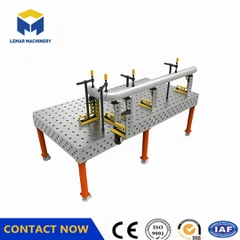
Next comes the surface itself, and this is where modularity ties directly to ergonomic function. A welding table's surface can't be too smooth (clamps slip) or too rough (workpieces get damaged, and cleaning takes forever). Universal tables use grid-patterned surfaces with standard 16mm or 28mm slots, spaced every 100mm or 150mm-this isn't arbitrary. The slot spacing lets you attach clamps, jigs, and fixtures at precise, consistent points, so you don't waste time measuring and adjusting every part of your setup. But the surface material matters too. Cast iron is common for heavy-duty work because it's rigid and doesn't warp under heat, and cast iron's density also helps reduce vibration, which is crucial for stable welds and less hand fatigue. We offer a 3D Casting Welding Table that's cast from high-grade iron, and its surface is precision-machined to within 0.05mm flatness-so when you set a large workpiece, there's no wobble that would force you to readjust your posture mid-job. For smaller shops or hobbyists, our 3D Welding Table Top is a popular choice: it's lightweight enough to move if needed, but still durable enough for MIG, TIG, and stick welding. You can check out our 3D Welding Table Top here.
Wait, let's dive into TIG specifically, because TIG welders have unique ergonomic needs. TIG welding requires steady hand movement and close attention to detail, so anything that throws off their balance or focus is a problem. That's why our Tig Welding Table Top is designed with smaller, more spaced slots (100mm instead of 150mm) and a slightly lower overall profile-perfect for sitting positions, which TIG welders often use. The surface is also coated with a heat-resistant, anti-spatter finish that's easy to wipe clean; no more scraping spatter off the table mid-job, which would break your concentration and force you to bend down unnecessarily. I've heard from TIG welders who used generic workbenches that they'd spend 15 minutes every hour cleaning their table, but with our Tig Welding Table Top, that time is cut to less than two minutes. That's a tangible ergonomic win-more time welding, less time on upkeep.
Another key ergonomic feature is the table's weight capacity and load distribution. A lot of basic workbenches have a high weight limit, but they're not designed to handle uneven loads-like a 500lb steel beam resting on one end, while the other end is empty. That causes the table to sag, which makes your workpiece tilt and your welds uneven. Universal welding tables are engineered with a reinforced frame that distributes weight evenly across the entire surface, even when you're clamping large, irregular workpieces. This means you don't have to bend or stretch as far to reach the center of the table, reducing the risk of muscle pulls. Our 3D Welding Platform For Metal Fab is built with a 2,000lb static load capacity, and its frame uses thick steel cross-braces that prevent sagging even when heavy materials are clamped off-center. That stability isn't just about better weld quality-it's about reducing the physical stress of working with bulky materials.


Storage and accessibility are also part of ergonomic design that's often overlooked. When your clamps, fixtures, and tools are scattered around the shop, you're constantly walking back and forth, which adds fatigue over a long shift. Universal welding tables often come with built-in drawer systems, side shelves, or pegboard attachments directly on the table's frame, so you can keep your most-used tools within arm's reach. For example, many of our universal tables have a 2-tier under-table storage cart that rolls out from the side, so you don't have to bend down low to grab a clamp or a wrench. Some larger models even have integrated cable management, so welding leads and gas lines don't get tangled under your feet, which is a safety hazard and a nuisance. I remember a welder who told me he tripped over his welding lead three times in one day on a generic table; switching to our universal table with cable guides eliminated that problem entirely.
Now, let's talk about how these features come together for different users. A hobbyist doing small metal projects at home might prioritize a compact, adjustable table with a lightweight surface-something that's easy to move around their garage. A small fabricator doing custom furniture or railings might need a mid-sized table with modular slots that work for both small parts and larger assemblies. A large industrial shop working on heavy machinery parts would need a heavy-duty, cast-iron table with high load capacity. That's why calling it a "universal" table makes sense: it adapts to your specific needs, instead of forcing you to adapt to it. If you're looking for options that fit different workflows, our Best Welding Workbenches page has a breakdown of models for every shop size, from home hobby to industrial. You can browse the Best Welding Workbenches here.
But let's be clear: ergonomic design isn't just about comfort-it's about long-term health. Welders are prone to repetitive motion injuries, carpal tunnel syndrome, and back problems because of the physical demands of their work. A table that's adjustable, stable, and has tools within reach reduces those risks. That's why we work with occupational safety experts to design our universal welding tables, making sure every slot spacing, height range, and storage feature is optimized for the human body. For example, the slot spacing is based on the average reach of an adult's arm, so you don't have to stretch more than 18 inches to reach any clamp on the table. The height adjustability range is set to match the recommended standing height for people of different heights, so even shorter welders can set the table to a comfortable level without hunching.
I've seen the difference this makes firsthand. Last year, a custom bike shop came to us with three welders who were all dealing with shoulder pain from working at fixed-height tables. They invested in three of our adjustable universal tables, and after six months, their shop's workers' comp claims for musculoskeletal issues dropped by 70%. That's not just a win for the welders-it's a win for the shop's productivity, too. When employees are comfortable and in less pain, they work faster and make fewer mistakes. Welding is a precision job, and even a small amount of distraction from physical discomfort can lead to wasted material or rework.
Another often-missed detail is the table's edge design. Sharp metal edges on a basic workbench can cause cuts when you're moving large workpieces, or they can catch on your sleeves, leading to accidents. Universal welding tables have rounded, smooth edges that are designed to prevent these injuries. Some models even have integrated drip pans around the table's perimeter to catch welding spatter or coolant, so it doesn't drip onto the floor (a slip hazard) or build up on the table's surface (making it hard to move workpieces). That's a small feature, but it adds up to a safer, more ergonomic workspace.
Let's circle back to the surface material for a second, because it's not just about durability-its heat resistance is a big part of ergonomics. When you're welding, spatter can fly onto the table surface, and if the table is too thin, it might warp or get damaged. But even more importantly, a surface that retains heat can make the table too hot to touch, forcing you to wait for it to cool down between jobs, which wastes time. Our cast iron surfaces, like the ones in our 3D Casting Welding Table, dissipate heat quickly, so you can switch between welding jobs without waiting. That's a small time-saver, but it adds up to more hours of productive work over a week.
So, what should you look for when evaluating a universal welding table's ergonomic design? Start with adjustability: can you tweak the height to suit your preferred working position (standing, sitting, or a mix)? Then, check the surface: is it rigid enough to prevent wobble, with slots spaced for easy clamp placement? Look for storage and accessibility features: are your tools within arm's reach, without needing to bend or walk across the shop? And don't forget safety: are the edges smooth, and is there a way to manage cables and spatter?
As a supplier, we don't just sell tables-we provide equipment that makes welders' jobs easier. That's why every one of our universal welding tables is designed with ergonomics at the core, tailored to the unique needs of welding professionals. Whether you're a hobbyist looking for a table for your home garage or a large industrial fabricator needing heavy-duty equipment, we have options that fit your workflow. If you're ready to explore how a universal welding table can improve your shop's productivity and your team's comfort, get in touch with us to discuss your specific needs. We'd be happy to walk you through our product lineup, including our 3D Welding Table Top, Tig Welding Table Top, 3D Welding Platform For Metal Fab, 3D Casting Welding Table, and Best Welding Workbenches, to find the perfect fit for you.
Send Inquiry