


What is the function of a lock washer?
Dec 12, 2025
Leave a message
A lock washer is a small yet crucial component in many fastening systems, playing a significant role in ensuring the stability and safety of various structures and equipment. As a professional lock supplier, I have witnessed firsthand the importance of lock washers in different applications. In this blog post, I will delve into the functions of lock washers, exploring their mechanisms and highlighting their significance in diverse industries.
Preventing Loosening
One of the primary functions of a lock washer is to prevent nuts and bolts from loosening due to vibration, shock, or other dynamic forces. When a nut is tightened onto a bolt, the threads create a frictional force that holds the two components together. However, under certain conditions, such as high - frequency vibrations or large - scale shocks, this frictional force may be overcome, causing the nut to gradually unwind.


Lock washers work by introducing an additional source of tension and friction. For example, split lock washers have a split design that creates a spring - like effect. When compressed between the nut and the surface of the joint, the split washer exerts a radial force against the nut and the bolt, increasing the contact pressure and enhancing the frictional resistance. This additional friction helps to keep the nut and bolt in place, reducing the likelihood of loosening.
External tooth lock washers and internal tooth lock washers operate on a similar principle. Their teeth bite into the surface of the nut and the mating part, providing a locking action that resists rotation. In machinery where parts are subject to continuous vibration, such as engines or industrial equipment, the use of lock washers can significantly improve the reliability and longevity of the connections.
Distributing Load
Another important function of a lock washer is to distribute the load evenly across the joint surface. When a nut is tightened, the pressure is concentrated at the point of contact between the nut and the bolt head. This uneven distribution of load can lead to local deformation of the joint surfaces, which may cause premature wear and failure of the fasteners.
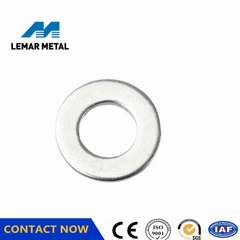
Lock washers act as a buffer between the nut and the surface, spreading the load over a larger area. Flat lock washers, for instance, are commonly used to distribute the load evenly. They have a flat, circular shape that provides a smooth surface for the nut to rest on. By increasing the contact area, the lock washer reduces the stress concentration at the joint, preventing damage to the mating surfaces and ensuring a more secure connection.
In applications where the joint is subjected to high loads or where the materials have low hardness, the use of lock washers for load distribution is particularly important. For example, in bridge construction or heavy - duty machinery, proper load distribution can enhance the structural integrity of the joints and prevent catastrophic failures.
Protecting Surfaces
Lock washers can also protect the surfaces of the components being fastened. During the tightening process, the nut or bolt may cause scratches or damage to the mating surface, especially if the surface is made of a soft material. A lock washer can act as a barrier between the fastener and the surface, preventing direct contact and minimizing the risk of surface damage.
Moreover, in some environments where corrosion is a concern, lock washers made of corrosion - resistant materials can help protect the fasteners and the joint surfaces. For example, stainless - steel lock washers are often used in outdoor or marine applications to prevent rust and corrosion, which can weaken the fasteners and compromise the integrity of the connection.
Applications in Different Industries
The functions of lock washers make them indispensable in a wide range of industries. In the automotive industry, lock washers are used in engine components, suspension systems, and steering mechanisms to ensure that critical parts remain securely fastened. The constant vibrations and high - speed movements in vehicles require reliable locking solutions, and lock washers play a vital role in maintaining the safety and performance of automotive systems.
In the construction industry, lock washers are used in structural steelwork, building frames, and bridge construction. They help to secure bolts and nuts in place, ensuring the stability and durability of the structures. For example, in a high - rise building, the proper use of lock washers can prevent loosening of the fasteners due to wind loads and seismic activity.
In the electronics industry, lock washers are used in the assembly of electronic devices to prevent components from coming loose. The small size and high precision of electronic components require fasteners that can provide a secure and stable connection, and lock washers meet these requirements effectively.
Our Product Offerings
As a lock supplier, we understand the diverse needs of our customers in different industries. We offer a wide range of lock washers, including split lock washers, external tooth lock washers, internal tooth lock washers, and flat lock washers. Our lock washers are made of high - quality materials, such as carbon steel, stainless steel, and brass, to ensure excellent performance and durability.
In addition to lock washers, we also provide a variety of locks, such as Door Pad Lock, Polished Brass Padlock, and Door Lock Bolt. Our products are designed to meet the highest standards of quality and security, and we are committed to providing our customers with the best possible solutions for their locking needs.
Conclusion
In conclusion, lock washers are essential components in fastening systems, performing functions such as preventing loosening, distributing load, and protecting surfaces. Their importance cannot be overstated in various industries, where reliable and secure connections are crucial for the safety and performance of equipment and structures.
If you are in the market for high - quality lock washers or other locking products, we invite you to contact us for procurement and洽谈. Our team of experts is ready to assist you in finding the right solutions for your specific requirements.
References
- Machinery's Handbook, 31st Edition
- Fastener Technology: Principles and Applications, by Henry Petroski
Send Inquiry