




How to increase the temperature resistance of a 3D precision welding table?
Oct 02, 2026
Leave a message
As a supplier of 3D precision welding tables, I've encountered numerous challenges and requirements from clients. One frequent question is how to enhance the temperature resistance of these tables. High temperatures can pose significant risks during the welding process, including deformation, reduced structural integrity, and impaired precision. In this blog, I'll share some effective strategies to boost the temperature resistance of a 3D precision welding table.
1. Material Selection
The choice of material is fundamental in determining the temperature resistance of a 3D precision welding table. High - quality materials with excellent heat - resistant properties are essential.
Steel Alloys
Alloy steels are a popular choice. For instance, stainless steels contain chromium, which forms a protective oxide layer on the surface when exposed to high temperatures. This layer prevents further oxidation and corrosion, allowing the table to withstand elevated heat without significant degradation. Some specialized high - temperature alloy steels can retain their strength and dimensional stability even at temperatures exceeding 500°C.
Cast Iron
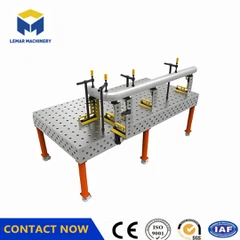
3D Welding Cast Iron Platform is another option. Cast iron has good heat - retaining properties and can dissipate heat relatively evenly. It has a high thermal mass, which means it can absorb a large amount of heat energy without a rapid increase in temperature. This characteristic helps in reducing the thermal stress on the table during welding.
2. Heat Treatment
After selecting the appropriate material, heat treatment can further improve the temperature resistance.
Annealing
Annealing is a process where the welding table is heated to a specific temperature and then cooled slowly. This process relieves internal stresses in the material, which are often generated during the manufacturing process, such as casting or machining. By eliminating internal stresses, the table is less likely to deform under high - temperature conditions.


Quenching and Tempering
For steel - based welding tables, quenching and tempering can significantly enhance their mechanical properties, including temperature resistance. Quenching involves rapidly cooling the heated steel, which hardens the material. However, this process also makes the steel brittle. Tempering, which is a subsequent heating and slow - cooling process, reduces the brittleness while maintaining the hardness, resulting in a material that can better withstand high temperatures without cracking.
3. Surface Coating
Applying a suitable surface coating can create a protective barrier between the welding table and the high - temperature environment.
Ceramic Coatings
Ceramic coatings are well - known for their excellent heat - resistant properties. They have low thermal conductivity, which means they can insulate the underlying material from the intense heat of welding. These coatings can withstand very high temperatures, sometimes up to 1000°C or more. A ceramic - coated welding table not only resists heat better but also reduces the adhesion of molten metal and slag, making it easier to clean.
Thermal Barrier Coatings (TBCs)
TBCs are engineered to provide a high level of thermal insulation. They are typically composed of multiple layers, each with different properties. The outer layer may be designed to reflect heat, while the inner layers can absorb and dissipate it. By using TBCs on a 3D precision welding table, the temperature of the underlying material can be significantly reduced, thereby increasing its overall temperature resistance.
4. Cooling Systems
Incorporating cooling systems into the design of the welding table can effectively manage the heat generated during welding.
Liquid Cooling
A liquid - cooling system can be installed within the welding table. In this system, a liquid, usually water or a specialized coolant, circulates through channels or pipes embedded in the table. As the coolant flows, it absorbs heat from the table and transfers it to a heat exchanger, where it is dissipated. Liquid - cooled Grid Welding Fixture Table can maintain a relatively low operating temperature, even during prolonged and intense welding operations.
Air Cooling
Air - cooling systems rely on the circulation of air to remove heat from the welding table. This can be achieved through natural convection or forced - air methods. In forced - air cooling, fans are used to blow air over the surface of the table, accelerating the heat - transfer process. Air - cooled systems are relatively simple and cost - effective, making them suitable for many applications, especially those with moderate heat - generation requirements.
5. Structural Design
The structural design of the 3D precision welding table also plays a crucial role in its temperature resistance.
Reinforcement
Adding structural reinforcements, such as ribs or braces, can increase the table's strength and stiffness. This helps to prevent deformation under high - temperature conditions. Reinforcements can be strategically placed in areas where the stress is likely to be concentrated, such as around the welding zones.
Modular Design
A D28 3D Fixture Welding Table with a modular design allows for better heat dissipation. The modular components can be arranged in a way that promotes air circulation between them. This reduces the overall heat buildup in the table and improves its temperature resistance.
6. Maintenance and Inspection
Regular maintenance and inspection are essential to ensure that the temperature - resistance features of the welding table remain effective.
Cleaning
Over time, debris, molten metal, and slag can accumulate on the surface of the welding table. These deposits can act as insulators, increasing the local temperature and potentially causing damage. Regular cleaning, using appropriate cleaning agents and tools, can remove these deposits and maintain the table's heat - transfer properties.
Inspection
Periodic inspections should be conducted to check for signs of wear, damage, or degradation. Any cracks, deformations, or coating failures should be addressed promptly. For cooling systems, the integrity of the pipes, pumps, and fans should be verified, and the coolant level and quality should be checked.
7. Compatibility with Welding Processes
Different welding processes generate varying levels of heat. It is important to ensure that the 3D precision welding table is compatible with the specific welding processes used.
High - Energy Welding Processes
For high - energy welding processes such as laser welding or electron - beam welding, which generate extremely high temperatures, the welding table needs to have enhanced temperature resistance. A Robot welding table used in automated welding systems may require more advanced heat - management solutions, such as a combination of liquid cooling and high - performance surface coatings.
Low - Energy Welding Processes
In contrast, low - energy welding processes like soldering or some types of arc welding may not require as extreme temperature - resistant measures. However, basic temperature - resistance features, such as a suitable material and surface coating, are still necessary to ensure the long - term performance of the table.
Conclusion
Increasing the temperature resistance of a 3D precision welding table is a multi - faceted approach. By carefully considering material selection, heat treatment, surface coating, cooling systems, structural design, maintenance, and compatibility with welding processes, we can create a welding table that can withstand high temperatures and maintain its precision and durability.
If you are in the market for a 3D precision welding table with excellent temperature resistance or have any questions about enhancing the performance of your existing table, please don't hesitate to contact us for in - depth discussions and procurement negotiations. We are committed to providing you with the best solutions for your welding needs.
Send Inquiry