

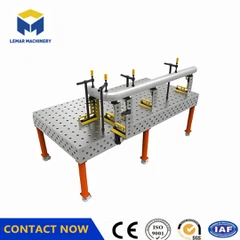
What are the effects of 3D welding table positioning deviation?
May 13, 2026
Leave a message
1. Deterioration in Welding Quality
Weld Misalignment: Inaccurate workpiece positioning causes the welding torch path to deviate from the intended trajectory, resulting in incomplete welds, missed welds, or uneven penetration.
Increased Welding Defects: Frequent defects such as porosity, slag inclusions, and cracks reduce weld strength and sealing, affecting product reliability.
Increased Rework Rate: Requires manual welding or rework, increasing costs and extending delivery cycles.
2. Mismatched Workpiece Assembly
Excessive Butt Joint Gap: Positioning errors during assembly of multiple components lead to misaligned holes and uneven joints, affecting overall structural strength.
Forced Assembly Induces Stress: Applying external force to forcibly close the workpiece causes stress concentration within the structure, reducing product fatigue life.
3. Reduced Production Efficiency
Repeated Fixture Adjustments: Manual position correction is required after each clamping, increasing auxiliary time and affecting production line cycle time.
Frequent Downtime for Troubleshooting: Frequent welding anomalies necessitate production interruptions for troubleshooting, reducing equipment utilization.
4. Accelerated Wear of Fixtures and Platforms
Local Stress Concentration: Deviations cause loose connections between fixture modules, placing additional stress on some connection points and accelerating wear on T-slots and positioning holes.
Increased Risk of Module Deformation: Long-term operation under abnormal conditions can easily lead to plastic deformation of precision modules such as standard angle rulers and square boxes.
5. Automation System Failure Risk
Vision Guidance Inaccuracy: If integrated with a 3D vision or laser positioning system, reference deviations can cause hand-eye calibration failures, preventing automatic compensation of the welding torch path.
Program Execution Abnormalities: The robot moves according to preset coordinates, but the actual workpiece position deviates, causing collisions or welding failures.
✅ Critical impact threshold: When the repeatability deviation exceeds ±0.1mm, the above problems will become significant. It is recommended to establish a monthly detection mechanism and calibrate and repair in a timely manner.
Send Inquiry